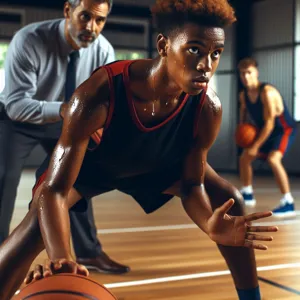
Basketball – What are the keys to becoming a good defender?
Credit : whatcanu.com
Defense is the engine of a winning basketball team. While offense fills the stands, defense secures the trophy. To become a standout defender, you must stop viewing defense as a reaction to the offense. Instead, treat it as a tactical game where you dictate the opponent’s options. Elite defense requires 20 percent athleticism and 80 percent discipline, spatial intelligence, and relentless effort.
The Defensive Stance: Managing Your Center of Gravity
Think of your defensive stance as a shock absorber. If you stand too tall, you are like a parked car—easy to move and slow to react. You must drop your hips until your thighs burn to stay effective. This low posture stabilizes your center of gravity and allows for explosive lateral movements.
Footwork: Keep your feet wider than your shoulders. If your feet are too close, you lose your balance every time your opponent shifts weight.
The Glide: Move by sliding your feet, never crossing them. Think of your legs like a piston in an engine; they push and pull to create power without locking up.
Weight Distribution: Keep your weight on the balls of your feet. If your heels touch the floor, you have already lost the first step of the race.
Mastering One-on-One Pressure
Credit : whatcanu.com
Defending the ball carrier is about removing their comfort zone. You do not need a steal to play great defense. Your goal is to force a lower-percentage shot or a pass. Use your body as a wall, not as a reach tool.
The Funnel Technique
Treat your body like a physical funnel. By positioning your lead foot toward your opponent’s dominant hand, you dictate their path. For example, watch how Marcus Smart forces players toward the sideline, away from the middle of the court. If you shade a right-handed player toward the left sideline, you narrow their passing angles. This forces them into a bottleneck where they have no choice but to pass or take a contested jumper.
Avoiding the Common Reach Trap
A classic rookie mistake is reaching for the ball. When you reach, you tilt your torso and break your stance. You become a statue that any decent ball-handler can blow past. Keep your hands in the passing lanes instead. Only swipe for the ball when the dribbler loses their grip or turns their back. Look at how Kawhi Leonard plays; he rarely reaches, yet he leads the league in disruption because he forces offensive players to make a mistake.
The Intelligence of Help Defense
Credit : whatcanu.com
You are not just responsible for your man; you are responsible for the basket. Help defense is about rotating before the drive happens. If you watch the ball handler and ignore your man, you allow back-door cuts. If you watch your man and ignore the ball, you allow open lanes.
The Triangle Concept
Maintain a mental triangle between you, the ball, and your assigned player. As the ball moves to the opposite side of the floor, move closer to the paint. This is like a security guard closing a gate. Your presence in the lane acts as a visual deterrent. During a game, look at Draymond Green; he constantly shifts his position to clog the lane, even when his man is on the perimeter. This mental awareness turns a standard defender into a defensive anchor.
The Power of Verbal Communication
Defense is a dialogue. If you are silent, you are failing your team. Screens are the most common source of breakdowns, usually because players do not communicate early. You must alert your teammates two seconds before contact happens.
Identify the Screen: Call out ‘Screen left’ or ‘Screen right’ loud enough for the whole gym to hear.
Define the Rotation: Command ‘Switch’ if you are trading, or ‘Stay’ if you are fighting over the screen.
The Help Call: If a teammate gets beat on a drive, scream ‘Help’ to signal that you are leaving your man to cover the basket.
Conditioning and The Fourth Quarter Test
Credit : whatcanu.com
Defense is physically demanding. You will often guard an opponent who only spends energy on offense. To sustain intensity through the fourth quarter, your training must match the game’s volatility. Do not just jog; perform lateral agility drills that mimic the chaotic nature of a defensive possession.
Try this drill: sprint, stop, and slide in a defensive stance for 30 seconds at a time. This mirrors a high-intensity possession in a real game. If your legs are weak, your technique will degrade. Once your knees rise and your stance straightens, you are no longer a defender; you are a target for the offense.
The Mindset of a Defensive Anchor
Great defenders possess a specific mental toughness. You must embrace the grind of a 24-second possession. When you defend someone effectively, you see their body language change. They start passing earlier or taking rushed shots. That is your ultimate sign of success. One bad play does not invalidate your effort. Reset, focus on the next possession, and force the offense to work for every inch of space.