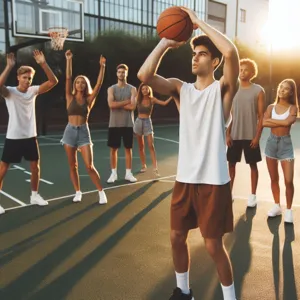
Becoming an elite shooter isn’t about natural talent; it is about engineering a repeatable motion. Think of your shooting form like a high-performance engine: if one component is misaligned, the whole system fails to deliver power. You must shift your focus from simply tossing the ball toward the rim to refining the kinetic chain that starts in your feet and ends in your fingertips.
Establishing Your Kinetic Chain
Credit : whatcanu.com
Your power originates from your base, not your arms. If your legs are stagnant, your upper body must compensate, leading to inconsistent distance and flat trajectories.
The Stance: Keep your feet shoulder-width apart with your lead foot slightly ahead of your dominant shooting side. This creates natural body alignment toward the rim.
The Dip: As you catch the ball, bring it down to your waist area before rising. This quick dip creates momentum, turning the act of shooting into a single, fluid motion rather than a two-part robotic movement.
Energy Transfer: Your knees should act as springs. Your shot release must coincide with the peak of your upward jump to maximize leverage.
The Geometry of the Release
The arc of your shot determines your margin for error. A flat shot forces the ball to enter the rim at a narrow angle, effectively making the hoop appear smaller. You want a high-arcing parabola.
Elbow Alignment: Keep your shooting elbow tucked, forming an ‘L’ shape. If your elbow flares out, you force your wrist to compensate, which kills your accuracy.
The Guide Hand: Your non-dominant hand is strictly for balance. It should detach from the ball the moment your upward motion begins. If your thumb ‘flicks’ the ball, you are introducing side spin that ruins your aim.
The Cookie Jar Follow-Through: Imagine a cookie jar on a high shelf. After release, your fingers should finish inside that jar. Hold this pose until the ball hits the target to ensure you aren’t rushing the mechanics.
Field-Tested Drill: The Form-Shooting Progression
Credit : whatcanu.com
Most players waste time shooting from the three-point line before their form is solid. Use this progression to build muscle memory:
One-Handed Close Range: Stand two feet from the hoop. Shoot using only your shooting hand. This forces you to find your balance and proper follow-through without the interference of a guide hand.
The 5-Spot Progression: Take ten shots from five spots inside the paint. Do not move to the next spot until you sink two in a row. This creates accountability under low-stakes pressure.
Catch-and-Shoot Simulation: Use a partner or a rebounder. Start with your back to the hoop, pivot, and face the basket in one motion. This trains your feet to find the target instantly.
Common Pitfalls to Avoid
Even seasoned players fall into bad habits during high-intensity games. Monitor these two frequent errors:
The ‘Push’ Shot: If you find yourself pushing the ball forward rather than flicking it upward, you are relying too much on your arm strength. Stop and go back to one-handed drills.
Rushing the Setup: Players often try to release before they have established their base. If your feet aren’t set, do not shoot. It is better to pass the ball and reposition than to put up a low-percentage shot.
The Role of Data and Technology
Credit : whatcanu.com
You can now measure what you feel. Modern wearable sensors and video analysis apps allow you to track your ‘arc angle’ and ‘shot rotation’ (RPMs). If you consistently miss long, your arc is likely too low. If you miss left or right, your alignment or your guide hand interference is the culprit. Use your smartphone to record your shot from the side and the front. Comparing your footage to high-level shooters will reveal micro-flaws that you simply cannot feel during the heat of a game.
Building Game-Ready Confidence
Confidence is the byproduct of preparation, not wishful thinking. If you have spent hours refining your mechanics in the gym, your brain will trust your body when the game is on the line. Use visualization: mentally walk through your pre-shot routine during your downtime. Visualize the ball rotation and the sound of the net. This mental rehearsal prepares your nervous system, ensuring that when the opportunity arises, your shot is an automatic reflex rather than a conscious decision.