
Mastering the Basketball Off-Season: A Professional Roadmap

The off-season is not a vacation; it is a tactical window to decouple your development from the constraints of team schedules. Elite players use these months to rebuild their physical infrastructure and refine technical mechanics that often deteriorate during the intensity of game play. If you approach these months with a generic workout plan, you are simply maintaining status quo while your competition pushes forward.
Defining Your Physical Architecture
Basketball is a sport of explosive transitions. Your strength program must prioritize force production and joint stability over hypertrophy. Stop wasting hours on machines that isolate muscles; focus on compound movements that train your body to function as a single unit.
- Force Production: Prioritize trap-bar deadlifts and split squats. These movements mirror the athletic stance and build the raw power required for vertical explosion.
- Force Absorption: Implement eccentric training—slowly lowering weights during squats—to build tendon resilience. Think of this as reinforcing the chassis of a car to handle high-speed turns.
- Lateral Integrity: Use Copenhagen planks and lateral lunges to strengthen the stabilizer muscles around the hips and ankles, which are the most common points of failure during cutting maneuvers.
The Mechanics of Shooting Consistency
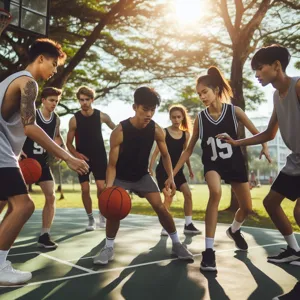
Shooting percentages often drop during the season due to fatigue and poor form habits. Use the off-season to deconstruct and rebuild your shooting mechanics. Consistency comes from repetition, but specifically from repetition of perfect form.
- The 1,000 Shot Rule: Focus on volume, but never at the expense of form. Track your makes, not just your attempts. If your form breaks down after 50 shots, stop and reset.
- Game-Speed Simulation: Never practice shooting at a leisurely pace. Use a partner to pass at game speed or use a shooting machine to simulate the transition from a sprint to a set shot.
- The “Form Loop”: Record your shot from three different angles. Compare the footage to professional shooters. Identify one micro-flaw—such as an elbow flare or a late release—and spend two weeks focusing exclusively on fixing that single variable.
Optimizing Anaerobic Capacity
Basketball is not a marathon; it is a series of 10-second sprints followed by minimal rest. Traditional steady-state distance running is counter-productive to basketball performance as it trains your body for slow, rhythmic movement.

Replace steady-state cardio with interval-based conditioning. A simple but effective method is the 1:3 work-to-rest ratio. Sprint for 15 seconds, then walk for 45 seconds. Perform this for 15 minutes. This mimics the stop-and-go nature of a fast-break offense and defensive recovery, ensuring you stay sharp during the final minutes of the fourth quarter.
The Psychological Competitive Edge
Most athletes ignore the mental component, which is equivalent to driving a high-performance engine without a steering wheel. Visualization is not meditation; it is mental rehearsal. Research shows that mental practice creates neural pathways similar to physical practice.
- Scenario Rehearsal: Spend five minutes daily visualizing high-pressure situations—being down by one point, the shot clock winding down, or facing a tight defensive trap. See yourself executing the correct decision.
- Data-Driven Accountability: Use a physical logbook or digital tracker to log every session. If you cannot measure it, you cannot improve it. Tracking your performance creates a feedback loop that highlights progress and prevents stagnation.
Common Pitfalls to Avoid
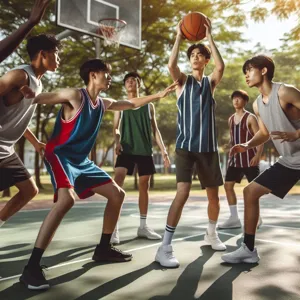
Even with the best intentions, players often fall into traps that stifle progress. Recognizing these early will save you weeks of wasted effort.
- The Over-Training Trap: Your muscles grow during rest, not during the workout. If your vertical jump is decreasing or your shooting touch feels “heavy,” you are likely over-training. Prioritize sleep as much as you prioritize your jump shot.
- Ignoring Mobility: Being strong is useless if your joints are restricted. If your ankles are tight, your jumping mechanics will compensate, leading to knee issues. Dedicate 15 minutes before every workout to deep-tissue work and joint mobilization.
- Neglecting Weak Sides: Most players are dominant on one side. Spend 60% of your skill training on your non-dominant hand. If you can drive, dribble, and finish comfortably with both hands, you become a defender’s nightmare.
View your off-season as an investment portfolio. If you put in the work on foundational strength, precise shooting mechanics, and sport-specific conditioning, you are guaranteed a high return when the season starts. Do not wait for a coach to tell you what to work on—take control of your development today.
Content updated on 2026-09-13