How can I improve my basketball conditioning?

Stop treating basketball conditioning like a marathon. If you are logging long-distance miles, you are training for endurance, not for the demands of the hardwood. Basketball is a game of high-intensity, short-duration bursts followed by active recovery. To dominate in the fourth quarter, you need to reorganize your energy systems to handle volatility.
Think of your body as a hybrid vehicle. Your anaerobic system is the battery that provides instant torque for a crossover or a dunk. Your aerobic system is the engine that recharges that battery during the walk back to defense. If your engine is small, your battery dies after the first quarter.
Mastering the Energy Systems
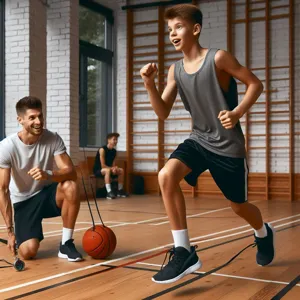
You cannot rely on one type of training. A well-conditioned player balances three specific physiological demands. If you neglect any of these, your performance will drop the moment the game pace increases.
- Anaerobic Power: This governs your ability to sprint for a loose ball. Train this with short, 5-to-10-second maximum effort bouts.
- Aerobic Efficiency: This acts as your recovery engine. Improved cardiac output allows your blood to flush out metabolic waste, such as lactate, that causes muscle burning.
- Neuromuscular Adaptation: This is the speed at which your brain tells your muscles to fire. It is the difference between an average player and someone with elite first-step quickness.
The Reality of Court-Based Conditioning
Ditch the treadmill. Scientific data shows that basketball players change direction or stop every 2 to 3 seconds. Your training must mimic this stop-and-start chaos to be effective.
- The 1:3 Work-to-Rest Ratio: Sprint at 100% intensity for 10 seconds, then actively recover (walk or light jog) for 30 seconds. Repeat this for 15 minutes. This forces your heart to adapt to intense oxygen debt.
- The 17-Stops Drill: Sprint from sideline to sideline 17 times in under 60 seconds. This is a classic test of deceleration. If you cannot stop your momentum quickly, you increase your risk of non-contact knee injuries.
- Defensive Shadow Slides: Perform 45 seconds of defensive sliding while holding a light medicine ball. Keep your hips below your knees. This simulates the isometric strain of staying in front of a shifty ball-handler.
Building Functional Strength for the Court
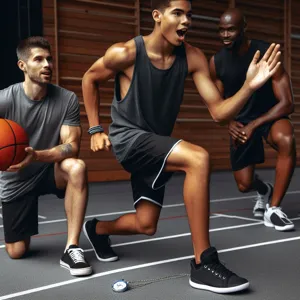
Basketball is an asymmetrical sport. You are rarely standing on two feet. You are constantly pivoting, landing from layups, and bracing for contact. Your strength training must address these imbalances to keep you on the court and out of the trainer’s room.
- Prioritize Unilateral Work: If you only do back squats, you are missing half the equation. Incorporate Bulgarian split squats or single-leg Romanian deadlifts. These movements identify and correct strength deficits in one leg versus the other.
- Posterior Chain Dominance: Your glutes and hamstrings provide the drive for your vertical jump. Use trap bar deadlifts to build raw power. The trap bar is safer for your lower back and allows you to move heavier loads than a conventional barbell.
- Anti-Rotational Core Work: Basketball requires you to maintain form while being bumped. Use Pallof presses to teach your torso to resist unwanted rotation. This keeps your shot stable even when you are exhausted in the final minutes.
Plyometrics: Managing the Stretch-Shorten Cycle
Think of your tendons as biological springs. Plyometrics teach those springs to store and release energy efficiently. The goal is to minimize the time your foot touches the ground. Treat the floor like it is made of hot lava.
- Pogo Jumps: Keep your knees nearly locked and jump using only your ankles. This builds stiffness in your Achilles tendon, which translates to a faster first step.
- Depth Jumps: Step off a 12-inch box, hit the ground, and immediately jump as high as you can. Your goal is to keep the ground contact time under 0.2 seconds.
- Lateral Skater Jumps: Push off one leg to jump sideways. This mimics the mechanics of a crossover dribble and conditions your knees to absorb lateral force.
Common Mistakes and Recovery Protocols

Hard training without a recovery strategy is simply digging a hole for your nervous system. If you finish every session feeling completely destroyed, you are likely overtraining and limiting your gains.
- The 48-Hour Rule: Never perform high-intensity plyometrics or heavy leg training within 48 hours. Your central nervous system takes longer to recover than your muscles do.
- Fueling the Engine: Stop playing on an empty stomach. Consume complex carbohydrates like quinoa or sweet potatoes 2-3 hours before tip-off. This prevents the mid-game energy crash.
- Mobility Over Static Stretching: Post-training, spend 10 minutes on foam rolling or dynamic mobility. Focus on the ankles and hips. A tight ankle is often the root cause of a strained knee.
Data-Driven Progression
If you don’t measure it, you are just guessing. Create a simple logbook. Track your weight room numbers, your sprint times, and your recovery heart rate. If your heart rate stays elevated for five minutes after a drill, your conditioning is not yet at a competitive level. Review your data every 8 weeks to adjust your intensity. This objective approach ensures you peak exactly when your season begins.
Content updated on 2026-08-26