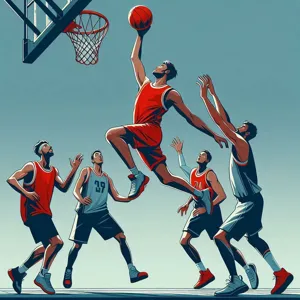
Basketball – What are the most important skills for a center?
Credit : whatcanu.com
Being a center today is not about standing under the hoop and waiting for a rebound. Modern basketball demands that you act as the team’s tactical anchor, linking defense to offense. You need to combine physical dominance with high-level decision-making to stay effective in a fast-paced game.
The Non-Negotiable Physical Foundations
Think of your body as the chassis of a truck. If it is not strong, the engine (your talent) cannot perform. You need functional strength to hold your ground in the paint.
Core Stability: Use weighted Bulgarian split squats to build unilateral leg power. This keeps you upright when a defender leans into your hip during a post-up.
Lateral Movement: Modern guards will force you to defend in space. Practice lateral slides with resistance bands. If your hips are stiff, you are a liability on the perimeter.
Explosive Verticals: Focus on depth jumps to increase your force production. This is the difference between snagging a rebound at its peak or just watching the ball hit the floor.
Common Pitfall: The Block-Chasing Trap
Credit : whatcanu.com
Many centers sacrifice defensive structure to hunt for highlight-reel blocks. Jumping at every pump fake pulls you out of position and grants the opponent an easy second-chance shot. Look at Rudy Gobert; he rarely chases blocks. He succeeds because he prioritizes verticality—keeping arms high and staying grounded. Your presence should disrupt the rhythm, not just pad your stat sheet.
Technical Mastery in the Low Post
The post is a game of leverage. If your defender gets their chest under yours, you have lost the leverage battle. Always aim to establish a wide base to protect your center of gravity.
The Drop Step: This is your primary weapon. Push off your outside foot to pivot into the paint. It is like a door swinging on a hinge; it must be fast and decisive.
The Counter-Move: Never become predictable. If you consistently spin over your right shoulder, an elite defender will read that on the first possession. Always drill a ‘step-through’ counter to exploit over-aggressive defenders.
Passing Under Pressure: Double-teams are inevitable. When the second defender arrives, find the open man immediately. Watch how Nikola Jokić waits for the defense to commit before delivering the pass. He treats the ball like a hot potato, keeping it moving before the defense can recover.
Defensive Anchoring: You Are the Floor General
Credit : whatcanu.com
As the center, you are the only player who sees the entire court. You must direct your teammates like a traffic controller. Call out screens, warn teammates about cutters, and organize the help-side defense.
Consider the ‘help-the-helper’ principle. If your point guard gets beaten on a drive, you are the final line of defense. You must rotate early to force the driver to dump the ball or take a tough, contested layup. Communication prevents the breakdown before it even starts.
Building Basketball IQ Through Observation
Credit : whatcanu.com
Physical stats get you on the floor, but your basketball IQ keeps you there. To improve, stop watching the ball during games. Instead, watch the movement of high-level centers like Bam Adebayo or Joel Embiid when they do not have the ball.
Actionable Tip: Watch game film with the volume off. Focus solely on how a center positions themselves to ‘seal’ a defender for a pass. Notice how they adjust their angle to maximize the passing lane for their teammates. By decoupling the visuals from the commentary, you force your brain to recognize patterns independently.
Recovery as a Performance Multiplier
The center position puts immense strain on the knees and ankles. If you ignore recovery, your game will fall off in the fourth quarter when your team needs your presence most.
Tissue Maintenance: Use deep-tissue foam rolling after every session to prevent micro-tears from turning into long-term injuries.
Refuel Window: Consume high-quality protein within 30 minutes post-training. Think of this as putting fuel back into a car after a long drive; it is the only way your muscles repair themselves.
Sustainability: Treat your rest days as part of your training plan. A center who remains healthy throughout the entire season is infinitely more valuable than one who plays at 100% capacity for only half of it.