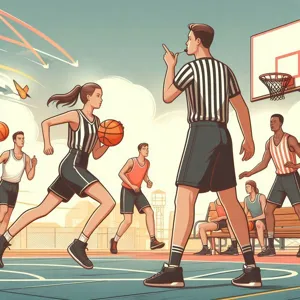
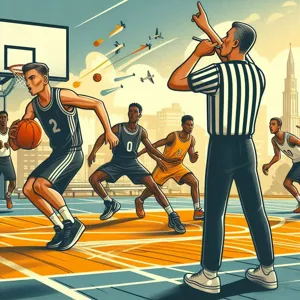
Basketball rules act as the framework that keeps the game structured. Without these limits, the game would descend into chaos. Mastering these regulations separates average players from those who truly understand the flow of the court. Whether you play for fun or in a competitive league, you must know these mechanics to avoid unnecessary turnovers.
The Scoring System and Spatial Awareness
The game objective is simple: outscore your opponent. However, your position on the court determines the value of your success. Shots inside the three-point arc grant two points. Shots from behind the arc earn three points. Free throws, taken from the charity stripe after a foul, grant one point each.
Pro Strategy: Treat the three-point line like a cliff edge. If your heel touches the line, your three-pointer becomes a two-pointer. Always scan the floor for the line before you initiate your shooting motion. Developing this spatial awareness ensures you never leave points on the table.
Fouls: Navigating Defensive Integrity
Credit : whatcanu.com
A foul is a penalty for illegal contact. Think of it like a traffic violation where you impede an opponent’s right of way. Personal fouls include pushing, holding, or hitting. In FIBA rules, a player is disqualified after five fouls. In the NBA, the limit is six. You must know your league’s specific limit to manage your aggressiveness.
Common Mistake: Many players reach in when they lose their defensive position. If you are behind an attacker, swatting at the ball usually leads to a foul. Instead, slide your feet to get in front of the ball handler. If you are not between the attacker and the hoop, you are effectively out of the play.
Violations: Traveling and Double Dribble
Violations result in an immediate change of possession. The two most common are traveling and double dribble. Traveling occurs when you move your pivot foot without dribbling. You must establish a stationary anchor before making your move.
Field Experience: Treat your dribble like a car engine. Once you pick up the ball with two hands, you have turned the engine off. You cannot restart it by dribbling again. A frequent error is stopping the dribble prematurely, which leaves you trapped without an exit strategy. If you pick up your dribble, pass or shoot immediately.
Shot Clock Variations: NBA vs. FIBA
Credit : whatcanu.com
The shot clock forces teams to maintain pace. In the NBA, you have 24 seconds to hit the rim. FIBA follows the same 24-second clock, but the nuance lies in the reset. Under FIBA rules, the clock often resets to 14 seconds after an offensive rebound, rather than a full 24. Understanding this ensures you know exactly how much time remains to execute a play.
Actionable Advice: When the clock shows under ten seconds, prioritize a shot toward the rim over a complex pass. A missed shot offers a chance for an offensive rebound. A shot clock violation gives the ball to the opponent without them having to work for it.
Defensive Verticality and the Three-Second Rule
Defense is defined by verticality. To contest a shot legally, jump straight up. If you jump into the shooter or drift horizontally, you commit a blocking foul. You must remain a stationary object to avoid contact penalties.
Credit : whatcanu.com
The Three-Second Trap: Offensive players cannot remain in the paint for more than three seconds. Beginners often park themselves near the rim, unaware they are stalling the offense. Step out of the lane every two seconds to reset the count. This keeps the defense guessing and clears space for your teammates.
Out-of-Bounds and Advanced Tactics
Boundary lines are absolute. If you touch the line or the floor outside while holding the ball, possession shifts. When saving a loose ball, your feet must be entirely inside the court when the ball leaves your hand.
Critical Checkpoint: Before you dive for a ball near the sideline, calculate your landing. If you are moving toward the out-of-bounds area, aim to bounce the ball off the opponent’s leg. This is a high-level play that uses the rules to your tactical advantage. Success in basketball requires playing within the lines while forcing your opponent to make mistakes outside of them.
Key Differences: NBA vs. FIBA Rules
Beyond the shot clock, other rules shift based on the organization. Recognizing these differences helps you adapt to different court environments.
Defensive Three Seconds: In the NBA, defenders cannot stand in the paint for three seconds unless they are guarding an opponent. FIBA does not have this rule, allowing for more traditional zone defense packing the lane.
Technical Fouls: NBA rules are strict regarding player conduct. A player or coach receiving two technical fouls is ejected. FIBA uses a similar system but often interprets unsportsmanlike conduct with different thresholds.
Court Dimensions: NBA courts are 94 feet long. FIBA courts are slightly shorter at 28 meters, roughly 91.9 feet. This three-foot difference changes the pacing of fast breaks and transition defense.