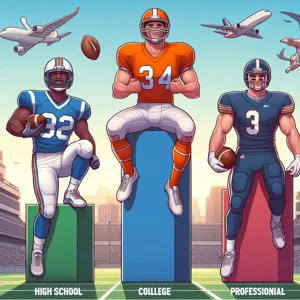
How do the different levels of American football (high school, college, professional) compare?
Credit : whatcanu.com
Transitioning from high school to the NFL is not just about growing larger or faster. It is a fundamental shift in processing speed and technical precision. Think of the difference between riding a bicycle in your neighborhood and racing a motorcycle on a professional track. The objective is the same, but the margin for error and the physics involved change completely.
High School Football: The Foundation of Raw Talent
High school football is defined by physical discovery. At this stage, superior athleticism often masks tactical deficiencies. If a player is faster or stronger than their peers, they will dominate regardless of the scheme.
Athletic Imbalance: You will often see drastic gaps in physical development. One player might have the muscle mass of a college senior, while another is still growing.
Strategic Simplicity: Coaching staffs manage limited practice time. Schemes are kept simple because players have not yet developed the cognitive framework for complex professional playbooks.
Resource Constraints: Most programs rely on volunteers and basic equipment. There is rarely an emphasis on data-driven recovery or advanced biomechanical analysis.
Field Reality: The Skill Gap
Credit : whatcanu.com
In high school, a defensive end can often record a sack simply by running around a slower offensive tackle. This reliance on raw speed creates a false sense of success. Players often reach the end of their high school career without learning advanced hand-fighting techniques, which creates a massive hurdle when they face disciplined collegiate defenders.
The NCAA Collegiate Gap: From Instinct to Systemic Intelligence
College football is the great filter. Every player on the field was once the star of their high school team. Athleticism is no longer a differentiator; it is the baseline expectation.
Positional Specialization: At the Division I level, you cannot win on talent alone. You must master specific techniques like internal leverage for linemen or reading complex zone drops as a linebacker.
Cognitive Load: College playbooks are roughly three times thicker than high school versions. A quarterback is expected to manage multiple pre-snap reads and hot routes within seconds.
Data Integration: Programs now use GPS technology to track workload. They monitor total distance covered and acceleration rates to prevent non-contact soft tissue injuries during the grueling season.
Common Pitfall: The Transition Trap
Credit : whatcanu.com
Many college recruits fail because they rely on their high school instincts. For example, a wide receiver who used to simply outrun defenders must now learn to use their hips to set up breaks in their routes. Failing to pivot from instinct-based play to systematic play is the primary reason players drop out of the rotation in their freshman year.
The NFL: Precision and Strategic Warfare
The NFL is an industry where milliseconds dictate career longevity. Physical parity is the standard, meaning mental processing speed is the only remaining competitive advantage.
Micro-Adjustments: At this level, a cornerback’s hip angle or a receiver’s route stem is measured in inches. These microscopic details separate a Pro Bowl player from an athlete released after one season.
Analytical Rigor: Teams employ full departments dedicated to sports science. They study thousands of hours of film to identify opponent tendencies, such as a quarterback’s inclination to throw to a specific side on third-down blitzes.
Financial Stakes: Professional football is a high-pressure environment. Every snap is recorded in high definition, affecting contract negotiations and long-term career viability.
Quantifying the Performance Leap
Credit : whatcanu.com
To understand the jump between these levels, consider these operational standards:
Game Speed: In high school, a pass rush might give a quarterback four seconds to throw. In the NFL, defensive ends run 40-yard dashes in under 4.6 seconds, forcing the ball to leave the hand in under 2.5 seconds.
Time Commitment: High school athletes train roughly 10-15 hours per week. NFL athletes operate in a 50 to 60-hour work model that includes intense film study, physical therapy, and tactical walkthroughs.
Medical Infrastructure: NFL teams provide full-time medical staff, including independent concussion spotters. This level of health maintenance is physically impossible to replicate at amateur levels.
Actionable Advice: How to Advance Your Level
If you are tracking progress for yourself or an athlete, avoid these common development traps:
Stop Obsessing Over Highlights: Stop training for the camera and start training for the fundamentals. Footwork, hand placement, and blocking angles are the boring tasks that actually win games.
Prioritize Film Study: The most common error is relying on athleticism. Successful players spend more time watching tape than they do lifting weights. If you cannot explain the ‘why’ behind a defensive coverage, you are playing at a high school level regardless of your speed.
Professionalize Recovery: High schoolers often wear pain as a badge of honor. Professional athletes treat recovery—sleep cycles, nutrition, and soft-tissue work—as a non-negotiable part of the job. Neglecting this leads to the chronic injuries that truncate athletic careers early.
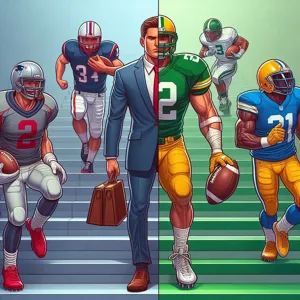
The transition through these levels is a process of refinement. High school provides the spark, college builds the engine, and the professional level requires the mastery of complex systems. Success is rarely about who is stronger; it is almost always about who is better prepared.