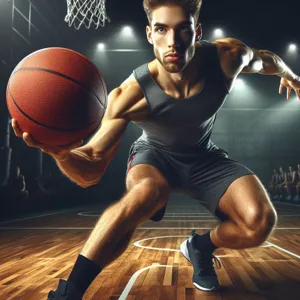
Basketball – What are the best drills to improve your dribbling skills?
Credit : whatcanu.com
Dribbling is the core engine of your offensive arsenal. Without elite ball control, your shooting mechanics and passing vision are irrelevant because you cannot reach your spots. Many players waste hours on flashy moves seen online before mastering the fundamental physics of the ball. To become an elite handler, you must stop treating dribbling as an instinct and start viewing it as a technical discipline.
The Mechanical Foundation: Posture and Touch
Your stance is the chassis of your game. If you stand upright, your center of gravity remains high, making you an easy target for defenders. Think of your body like a high-performance race car; you need a low suspension to handle corners at high speed. Keep your feet wider than shoulder-width, knees bent, and chest over your toes. This position keeps the ball closer to the floor, reducing the distance it travels and minimizing exposure.
Credit : whatcanu.com
Stop slapping the ball with your palms. Your palm is for catching, but your fingertips are for control. Using your palms creates a flat surface that offers zero grip and poor sensory feedback. Imagine your hand is a claw gripping the top of the leather. This tension allows you to manipulate the ball’s trajectory instantly, making your crossovers tighter and faster.
Advanced Drills for High-Pressure Environments
Drills are your personal software updates. If you do not push your limits, your game will remain outdated. Perform these four movements with maximum intensity to build authentic muscle memory.
The Violent Pound Dribble: Do not just bounce the ball. Pound it into the hardwood as hard as you can at waist height. The goal is to force the ball back to your hand instantly. This reduces your reaction time and trains your fingers to manage high-velocity impacts.
The Figure-Eight Weave: Dribble in a continuous figure-eight through your legs while keeping your eyes locked forward. This forces a weight transfer between your legs, mimicking the balance required for game-speed drives.
Dual-Ball Synchronicity: Dribble two basketballs simultaneously for three minutes. This drill forces your non-dominant hand to stop being a passenger. If you cannot dribble with both hands equally, your game will always have a ceiling. Spend 70% of your training time exclusively on your weaker hand.
Reactive Cone Zig-Zag: Place five cones in a line with two-meter gaps. Execute a specific move—crossover, between-the-legs, or behind-the-back—at every cone. Do not just go through the motions. Imagine a defender is mirroring your movement, and explode into the space after every change of direction.
Optimizing Your Mindset: Vision and Pace
Credit : whatcanu.com
Looking at the ball is a habit that separates amateurs from starters. If you watch the ball, you are blind to help-side defenders and open teammates. Practice dribbling while staring at a fixed point on the wall at eye level. If you can maintain high-intensity ball control for 60 seconds without a single glance downward, you are developing elite court awareness.
Pace variation is your most effective weapon against aggressive defense. Moving at one speed makes you predictable and easy to time. Adopt the stop-and-go method. Slow your dribble to draw the defender closer, then shift gears instantly to blow past them. It is similar to driving in traffic; the sudden change in velocity creates the gap needed to attack the rim.
Field Experience: Critical Errors to Eliminate
Credit : whatcanu.com
Even skilled players fall into traps that cap their growth. Audit your own training sessions for these three common failures.
Standing Too Tall: You are vulnerable if the ball bounces above your waist. Keep the ball at knee height when a defender enters your personal space.
Neglecting the Off-Hand: Use your non-dribbling hand as a shield. Keep it extended, but never push off. It acts as a barrier, forcing the defender to navigate around your arm to reach the ball.
Static Practice: A drill is useless if it is not performed at game speed. Set a timer for 30 seconds and operate at your maximum heart rate. If you lose the ball, sprint to retrieve it and reset immediately. You must train your body to handle the ball while you are physically exhausted.
Quantify Your Growth
Stop guessing your skill level and start tracking it. Record how many crossovers you can complete in 30 seconds with perfect control. If your numbers do not increase over two weeks, your intensity is too low. Record your training sessions on your smartphone and compare your mechanics to professional footage. If you see wasted, unnecessary hand movements, strip them away. Real mastery is found in the removal of the inefficient, leaving only the lethal essentials.