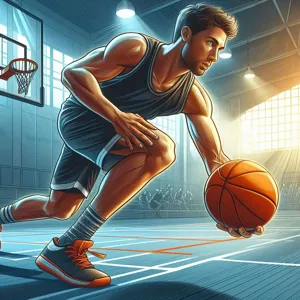
Elevate Your Play: Mastering Court Vision and Passing
Credit : whatcanu.com
Many players obsess over their jump shot or dribbling crossovers, yet they struggle to influence the game outcome. If you want to control the pace, you must master court vision. This is the skill of processing ten players’ positions simultaneously. Passing is merely the delivery mechanism for the high-IQ decisions you make. If you want to stop reacting and start orchestrating, you need to change how you look at the floor.
The Concept of Dynamic Scanning
Most players operate with tunnel vision. They fixate on the defender in front of them or the ball. To improve, treat your eyes like a security camera on a swivel. You cannot wait until you have the ball to start scanning. Your eyes must process the layout of the court before you even catch a pass. Think of this like checking your mirrors while driving: you need constant data updates to navigate traffic safely.
Master the head-up dribble: If you watch the ball, you are blind to the open man. Practice your ball handling while staring at a fixed point on the wall.
Implement the 3-second cycle: Train your eyes to rotate every three seconds: Rim, teammate, defender, open space.
Spot the mismatch early: Before you dribble, look for which defender is trailing their man. That is your primary target.
Practical Drills for Real-Game Speed
Credit : whatcanu.com
Static drills rarely translate to live action because they lack pressure. You need to train your brain to execute passes under physical fatigue. Here are two drills designed to replicate the chaotic nature of a real basketball game.
The Perimeter Decision Drill
Set up four cones in a semi-circle at the three-point line. Have a partner stand at the basket and hold up fingers representing a cone number (1-4). As you dribble at full speed, you must call out the number while changing your dribbling hand. On the final whistle, pass immediately to the cone corresponding to the last number shown. This forces you to split your focus between ball protection and visual cues.
The Shadow-Pass Reaction Drill
Credit : whatcanu.com
Pair up with a partner who acts as a defender between you and a target player. Your goal is to throw a pass that is physically impossible for the defender to intercept. The secret is the bounce pass aimed at the floor, specifically two feet away from the defender’s lead foot. This drill teaches you to prioritize pass trajectory over raw power.
Tactical Passing: Beyond the Basics
Elite playmaking is about manipulating the defense. If you stare at your teammate, the defender knows exactly where the ball is going. Use your eyes as a weapon to freeze the opposition. Look toward the corner while passing to the cutter under the basket. This is the basketball equivalent of a magic trick; you must direct the defender’s attention elsewhere to create an opening.
Technical Adjustments to Sharpen Your Delivery
Aim for the shooting pocket: Always deliver the ball to your teammate’s waist or chest. Never force them to reach down or behind their head.
The lead pass principle: Imagine your teammate is a wide receiver. Do not pass to where they are; pass to where they are going to be in two seconds.
Use the outside hand: Always deliver the pass using the hand furthest from the defender. This creates a natural wall between the ball and the steal.
Common Pitfalls and How to Correct Them
Credit : whatcanu.com
Even talented playmakers stall their team by falling into predictable habits. Here are the three most frequent errors I see on the court during film review sessions.
The Winding Wind-up: Many players pull the ball back to their chest before passing. This gives the defender a telegraph. Keep your passes compact and explosive.
The Over-Reliance on Flash: A simple, accurate chest pass is 100% better than a risky behind-the-back pass that results in a turnover. Stick to the high-percentage play.
Ignoring the ‘Help’ Defender: If you drive to the hoop and the defense collapses, stop trying to force the shot. That collapse means someone else is wide open.
Building Chemistry with Teammates
Vision isn’t just about what you see; it is about what you know. You should spend time learning the physical preferences of your teammates. Does your shooter prefer a bounce pass or a chest pass? By understanding these tiny details, you remove the guesswork from your passing. This allows your brain to focus entirely on reading the defense instead of worrying about the technical execution of the ball delivery.
The Mental Game of Passing
On game day, your heart rate will skyrocket. The biggest enemy of a good passer is the urge to rush. When you feel the pressure of the defense, take an extra dribble. That single heartbeat of patience can turn a contested, panicked pass into an easy layup for your team. Trust your preparation, keep your chin up, and always prioritize the smartest play over the showy one. The score sheet favors the person who makes the right choice, not the one who makes the highlight reel.