Mastering Basketball Ball-Handling: A Practical Guide
Credit : whatcanu.com
Ball-handling is the most critical technical foundation for any basketball player. If you cannot control the ball under pressure, you cannot control the game. This guide moves beyond theory to provide you with actionable steps to tighten your handle, improve your court vision, and become a more effective offensive threat.
1. Master the Fingertip Control
Many beginners make the mistake of slapping the ball with their palms. Think of your palms as the bumpers on a bowling lane—they provide a loose boundary, but they don’t give you precision. Your fingertips are your steering wheel.
The Drill: Start with stationary pound dribbles. Focus on using only your fingertips to manipulate the ball.
The Goal: You want to hear a sharp, rhythmic snap every time the ball hits the floor.
Feedback: If the ball makes a dull thudding sound, you are likely using too much palm.
2. Develop Ambidextrous Skills
Credit : whatcanu.com
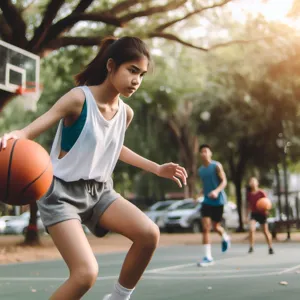
A one-handed player is predictable. If a defender knows you cannot go left, they will funnel you into traps and force turnovers. You must train your non-dominant hand until it mimics your primary hand.
Daily Ratio: Spend 70% of your training time on your weaker hand.
The Progression: Start stationary, move to walking dribbles, and finish with full-speed sprints.
Common Pitfall: Do not just switch hands during easy drills. Perform your entire warmup routine—including crossovers and between-the-legs moves—exclusively with your off-hand.
3. The Art of Eyes-Up Dribbling
Looking at the ball is a habit that limits your awareness. If your eyes are locked on the leather, you are blind to open teammates and defensive rotations. You need to develop spatial awareness, similar to how you naturally know where your keys are in your pocket without looking.
The Practice Trick: When dribbling, focus on a specific object at eye level across the gym.
Advanced Training: Try dribbling two balls at once. This forces your brain to delegate the dribbling to your subconscious, freeing your vision to scan the court.
4. Utilize Change of Pace and Direction
Elite ball-handling isn’t just about speed; it’s about deception. If you dribble at the same intensity all the time, you are easy to guard. You must learn to shift gears.
The Hesitation Move: Drive hard, then suddenly decelerate as if you are going to pick up your dribble. Defenders will often stand straight up in anticipation. That is your cue to explode past them.
Change of Direction: Always combine a change of pace with a change of direction. A crossover is twice as effective when preceded by a momentary pause.
5. Integrate Realistic Footwork
Credit : whatcanu.com
Your hands cannot work faster than your feet. If your feet are stuck in cement, your dribble will be ineffective regardless of how fast your fingers move.
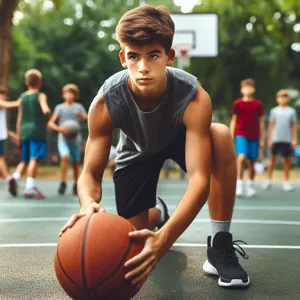
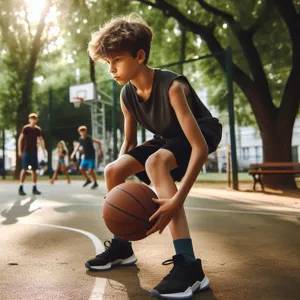
Low Stance: Keep your knees bent and your weight on the balls of your feet. This position acts like a coiled spring, ready to react to defensive shifts.
Pivot Training: Practice catching the ball and pivoting without traveling. Your dribble should always be an extension of your footwork, not a substitute for it.
6. The ‘Cone’ Method for Agility
Using obstacles is the fastest way to simulate a defender’s pressure. If you don’t have a partner, cones are your best friend for building muscle memory.
Zig-Zag Drill: Place cones in a line and dribble through them at full speed. Focus on changing hands at every cone.
Tight Control: Keep the ball low and tight to your body as you pass the cones. If you dribble wide, a real defender will swipe the ball away instantly.
7. Analyze and Adapt (The Feedback Loop)
Credit : whatcanu.com
Professional players constantly review their own tape. You should do the same. Record yourself during a practice session from different angles.
What to look for: Are you hunching over? Is the ball staying too high (above your waist)? Are your eyes scanning or fixed on the ground?
Adjustment: Compare your footage to clips of efficient guards. Isolate one flaw per week and fix it before moving to the next.
Error to Avoid: The ‘Flashy’ Trap
The most common mistake is focusing on streetball moves like complex behind-the-back combinations before mastering the basic pound dribble. Flashy moves are useless if you lose the ball on a simple drive. Build your house on a solid foundation of fundamentals first. Once your basic handle is secure under pressure, add the flair.
Final Advice: Consistency Over Intensity
It is better to practice for 20 minutes every day than for three hours once a week. Your muscles need consistent repetition to build the necessary fiber for reactive dribbling. Treat your ball-handling sessions as non-negotiable appointments. Over time, the ball will feel like an extension of your hand, and your confidence on the court will reflect that mastery.