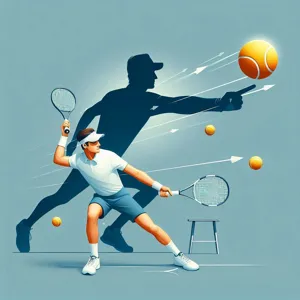
Accuracy in tennis isn’t about natural talent; it is about managing variables. Many club players mistake power for efficiency, but power without direction is just a gift to your opponent. To gain control, you must treat your shots as a series of mechanical inputs. If your input remains consistent, your output—the ball’s placement—will become predictable and precise.
The Geometry of Court Positioning
Credit : whatcanu.com
Accuracy begins before your racket touches the ball. You must respect the space between you and the incoming projectile. Think of your strike zone as a bubble floating around your body. If you let the ball enter your chest area, you are cramped and lose leverage. If you reach too far, you lose stability.
Master the Unit Turn: Rotate your shoulders the second you see the ball’s path. This movement is your reset button. It aligns your core and prepares your power source.
Respect the Arm’s Length: Maintain one full arm’s distance from the ball. If you feel claustrophobic, you will subconsciously pull your racket face inward, leading to those annoying shots that clip the tape of the net.
Small Adjustments: Think of these like the fine-tuning knob on a radio. Use rapid, short steps right before impact to keep your center of gravity neutral. Avoid planting your feet early.
Managing Your Racket Head
Your racket head is the steering wheel of the ball. If the face is open or closed by even a few degrees at impact, the ball will sail long or dive into the net. This is basic physics: the strings dictate the trajectory.
The Vertical Principle: At the moment of contact, your strings should be perpendicular to the court. Think of this as a palm-to-palm high-five with the ball. You are pushing it forward, not scooping it upward.
The Follow-Through Compass: Your finish dictates your destination. If your racket ends up across your body, the ball will follow that path. To hit deep, finish high and extend your arm toward your intended target zone like you are pointing at a specific spot on the fence.
Technical Drills for Pinpoint Placement
Credit : whatcanu.com
Stop hitting to the center of the court. That is where your opponent wants the ball. Use these drills to force your brain to map the court differently.
The Target Triangle: Place three tennis ball cans in the corners and the center. Aim to hit them in a specific sequence. This forces you to change your wrist angle for every shot, preventing stagnant habits.
The Depth Towel: Place a folded towel two feet inside the baseline. Any ball that lands short is a miss. You want to train your nervous system to prioritize depth over speed. A ball that bounces near the baseline forces your opponent to take a step back, shrinking their own window for an accurate return.
Visualization Swings: Perform 50 shadow swings where you visualize a specific target. If you can’t visualize where the ball should go, your body cannot execute the precise movement required to put it there.
The Serve: Strategic Targeting
The serve is the only shot where you have total control. If you lack accuracy here, you are failing to exploit your best weapon. Simplify your process to remove the noise.
The Toss Consistency: Your toss is the foundation. If your toss varies by an inch, your racket angle must make a massive correction. Practice releasing the ball at exact eye level every single time.
Zone Mapping: Never just aim for a general ‘in’. Divide the service box into three distinct sectors: wide, body, and T. Choose one before you start your motion. Even in practice, aim for a specific target to build the necessary neural pathways.
The Leg Drive: Don’t rely on your shoulder. Use your legs to launch your weight forward. A serve generated by the arm is erratic; a serve generated by the legs is repeatable because the large muscles of your legs are more stable than your shoulder joint.
Mental Calibration and Feedback
Credit : whatcanu.com
Consistency is impossible without honest feedback. If you don’t know why a shot failed, you are just guessing. Stop guessing and start analyzing.
The ‘Why’ Factor: After every error, ask yourself three questions: Was I late? Was my grip too tight? Did I lose my balance? If you identify the failure immediately, you convert a mistake into a lesson.
Grip Pressure: Imagine holding a small bird. You need to keep it from flying away, but you don’t want to crush it. Squeezing the handle too hard kills your wrist snap and makes your swing robotic and inaccurate. Keep your hand soft until the millisecond before impact.
The Eye-Lock Method: Keep your eyes glued to the ball until the strings make contact. A common mistake is looking at your target too early. This shifts your head and shoulder position, which causes your shot to spray wide.
Error Analysis: Common Pitfalls
Even seasoned players fall into traps that degrade their accuracy. Watch for these red flags during your next session.
The 75% Rule: Trying to hit with 100% power is the fastest way to lose control. Drop your intensity to 75%. You will find that hitting with controlled precision produces a harder ball for your opponent to return than a wild, high-speed strike that misses the line.
Static Recovery: If you stop moving after you hit, you are late for the next ball. A scramble is never accurate. Always perform a ‘split-step’ and return to the center of the court immediately. By staying active, you set yourself up to hit your next shot from a balanced, stable position.