Why Lip Blackheads Form
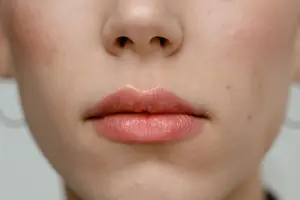
Blackheads around your lips are not typical acne. This area, known as the perioral zone, is a transition point between thin facial skin and the delicate mucosa of your lips. Imagine your pores as tiny funnels. When these funnels clog with a mix of natural sebum, dead skin cells, and residue from heavy lip balms, the debris oxidizes when exposed to air, turning dark. Because your mouth moves constantly when you talk or eat, this skin is under perpetual stress. This makes the pores here significantly more reactive than those on your forehead or nose.
The Danger of Mechanical Extraction
Many people treat lip blackheads like a standard blemish, using metal extractors or their nails to force out the blockage. This is a primary cause of long-term skin damage. The skin around your mouth is packed with nerve endings and blood vessels. Using force creates micro-tears in your skin barrier. Think of your skin barrier as a protective brick wall; once you create cracks in it, you invite bacteria in. This often leads to cystic acne or permanent scarring in a highly visible area.
Effective Chemical Exfoliation
Stop scrubbing the area. Physical scrubs with granules, like sugar or walnut shells, are like sandpaper on delicate skin. They cause micro-abrasions that trigger your skin to produce excess oil as a defensive response. Instead, rely on chemistry. Salicylic Acid (BHA) is your best tool here. Because it is oil-soluble, it dives deep into the pore lining to dissolve debris from the inside out. Use a 2% BHA solution on a cotton swab twice a week, staying strictly on the skin and away from the wet lip tissue.
The Double Cleansing Protocol
Your lip products might be the silent saboteur of your skin. Many long-wear lipsticks and heavy balms contain waxes designed to stay on your skin for hours. These waxes act like a sealant, trapping oil and dirt inside your pores. A standard face wash often fails to break these down. Switch to a double-cleanse routine every night. First, use an oil-based cleanser to melt the waxes. Follow this with a gentle water-based cleanser to lift away the debris. This two-step process ensures that no residue is left behind to oxidize overnight.
Identifying Hidden Culprits
If your blackheads persist, look at your daily hygiene habits. Ingredients in your toothpaste might be causing irritation, known as contact dermatitis, which swells the skin and traps oil. Specifically, Sodium Lauryl Sulfate (SLS) is a common foaming agent that acts as a potent irritant for many people. Try switching to a sensitive, SLS-free toothpaste for four weeks. Additionally, review your lip balms for high concentrations of shea butter or mineral oil, which are notoriously comedogenic. If a product feels heavy or creates a thick film, it is likely clogging your pores.
The SPF Connection
Sun exposure is a hidden accelerator of pore congestion. UV rays degrade your collagen, which acts as the structural frame holding your pores tight. When this frame weakens, your pores lose their elasticity and stretch out, making them look larger and allowing them to fill with debris more easily. Use a light, fragrance-free mineral sunscreen around your mouth every morning. Mineral formulas, often containing zinc oxide, are less likely to irritate this sensitive skin compared to chemical filters.
Real-World Expectations
Skin turnover is a slow process, typically requiring 28 days for new cells to reach the surface. Do not expect results in three days. You should look for a gradual improvement in texture over four to six weeks. If you see persistent redness, flaking, or pain, you are likely dealing with something other than blackheads, such as perioral dermatitis. In these cases, active acne treatments will only make the condition worse. If your symptoms do not subside with a simple, non-irritating routine, schedule a visit with a dermatologist. Professional intervention is necessary to rule out inflammatory conditions that require prescription-strength management rather than over-the-counter solutions.
Content updated on 2026-10-18