How Important Is a Strong Offensive Line in American Football?
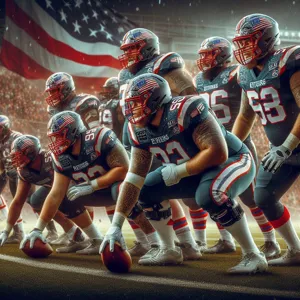
In American football, fans often chase the flash of a star quarterback or a record-breaking wide receiver. However, the outcome of any game is decided in the trenches. An offensive line is not merely a group of blockers; it is the infrastructure of your entire offensive system. If your line fails, your most expensive skill players become effectively useless.
The Mathematical Reality of Pressure
You cannot hide a weak offensive line. Statistics consistently show that when a quarterback is pressured on more than 30% of his dropbacks, his completion percentage plummets by up to 20%. Think of this like trying to type a complex report while someone intentionally bumps your desk every three seconds. You might finish the task, but the quality, speed, and accuracy will inevitably suffer.
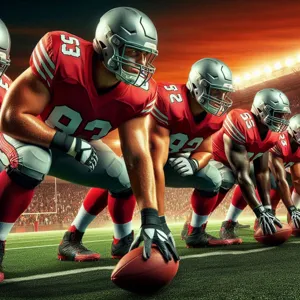
When the pocket collapses, the quarterback loses his ability to scan the field. He is forced to resort to panic-throwing or scrambling, which skyrockets the risk of interceptions and fumbles. Investing in your offensive line is an investment in risk mitigation. A clean pocket creates the window of time necessary for complex passing routes to materialize.
The Physics of Leverage and Kinetic Energy
Success as an offensive lineman is rarely about raw weight. It is entirely about leverage. Consider the simple mechanics of pushing a heavy sofa across a carpet. If you push from high up, you get nowhere. If you drop your hips and generate force from your base, the object moves easily. The same principle applies when blocking a defender.
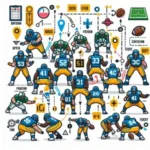
To build a high-performance unit, you must optimize these three measurable technical metrics:
- Pad Level: In 90% of successful blocks, the offensive player maintains a center of gravity lower than his opponent. Newtonian physics dictates that the lower force is harder to displace.
- Hand Punch Timing: A precisely timed strike to the defender’s chest plate disrupts his momentum before he gains an edge. If your hands arrive late, you have already lost the leverage battle.
- Base Width: Your feet must remain slightly wider than your shoulders. If your feet are too narrow, a single lateral juke move from a pass rusher will put you off-balance and on the ground.
The Myth of Individual Talent
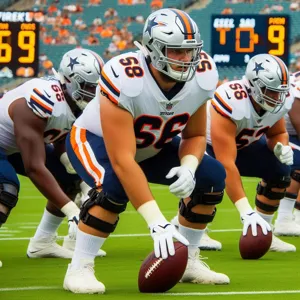
Coaches often fall into the trap of recruiting five individual superstars. This strategy fails because an offensive line must function as a single, synchronized machine. If one guard misses a communication cue regarding a blitz, the entire blocking scheme collapses. No amount of individual athletic talent can compensate for a broken internal rhythm.
Field Experience: I once worked with a program that invested heavily in a high-profile draft prospect at tackle, yet their passing game remained bottom-tier. The issue was not lack of talent; it was lack of chemistry. The interior line struggled to identify stunts, causing the star tackle to be left on an island. You are far better off with five average players who communicate perfectly than three elites who are operating on different wavelengths.
Communication as a Tactical Weapon
The true hallmark of a championship-caliber line is the noise level at the line of scrimmage. If your linemen are silent, they are guessing. A high-functioning unit identifies the Mike linebacker and resets their blocking assignments within three seconds of breaking the huddle.

Common Pitfall: Many coaching staffs obsess over off-season bench press records. While raw strength is a prerequisite, it is useless if the player does not know who to block. You should prioritize film study and verbal communication drills over weight room numbers. A lineman who knows exactly where to be is twice as valuable as a lineman who is physically dominant but mentally lost.
The ROI of Your Offensive Line
If you are responsible for roster management, treat your offensive line as your primary resource. Data indicates that teams with a top-ten ranked offensive line improve their overall points-per-drive efficiency by 18% on average. You are not just pushing bodies; you are buying time for your quarterback to make winning decisions.
Never treat your line as an afterthought. You can have the fastest wide receiver in the league, but if your line cannot hold their block for 2.5 seconds, that receiver will never even touch the ball. Building from the inside out is the only sustainable path to success. Respect the trenches, and your offense will find the consistency required to win games.
Content updated on 2026-09-28