How does the quarterback’s leadership impact a team’s success in American football?
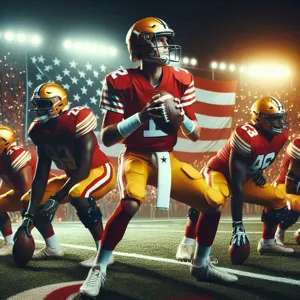
In American football, the quarterback acts as the field general. Their impact goes far beyond throwing a ball; it is about managing the psychological and tactical state of ten other players. If the offensive line is the engine, the quarterback is the navigation system. A faulty navigation system leads the entire vehicle into a crash, regardless of how much horsepower the engine provides.
The Cognitive Load: Processing Information at Velocity
A quarterback must process massive amounts of data in seconds. Think of this like a high-frequency trader on the stock market. They have a split second to analyze incoming information and execute a transaction. If they hesitate, they lose capital. On the field, this capital is measured in down-and-distance efficiency.
The mechanics of effective field leadership:
- Pre-snap diagnostics: Elite quarterbacks scan the defense to identify the ‘mike’ linebacker and potential blitz packages. It is akin to a driver spotting a traffic jam three miles ahead and changing lanes early.
- Cadence as a weapon: Using the snap count to force the defense into showing their hand. By varying your rhythm, you gain a one-second head start. This extra time is the difference between a clean pocket and a sack.
- Emotional regulation: Your body language after a turnover dictates the team’s spirit. If you drop your head, you signal to your teammates that the game is over. If you immediately move to the next play, you hold the unit together.
The Infrastructure of Trust: Building Professional Relationships
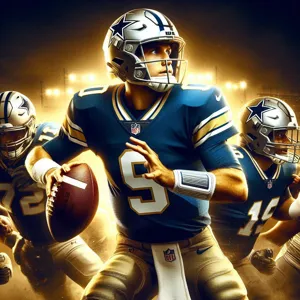
Young players often mistake leadership for being the loudest person in the huddle. This is a common error. Leadership in the NFL is built in the film room, not through speeches. You must prove your value to the offensive linemen before you ever take a snap.
Lessons from the trenches:
- Invest in your protectors: The offensive line is the most thankless job on the field. When you acknowledge their blocks, they play harder. A quarterback who builds genuine, off-field rapport with his linemen gains their total commitment during the game.
- Radical ownership: When a play fails, the quarterback must own their contribution to the mistake first. If you threw the ball too far inside, admit it. This stops the blame game, which is the fastest way to destroy team chemistry.
- Precision communication: Use concise, actionable language. Do not tell a receiver to ‘run hard.’ Tell them to ‘run the post and break at fifteen yards.’ Clarity kills hesitation, and hesitation causes turnovers.
Quantifying Leadership: Beyond the Stat Sheet
Passing yards are misleading. They are a volume stat, not a leadership stat. To measure the true impact of a quarterback, look at efficiency metrics that determine victory in tight games.
- Third-down conversion rate: This is the ultimate test of leadership under pressure. Can you keep the chains moving when the defense is bringing their most exotic blitzes?
- Red zone touchdown percentage: Accuracy is secondary here. Success in the red zone requires identifying coverage in a compressed space where there is zero margin for error.
- Turnover margin: A leader values possession over a spectacular highlight. Prioritizing ball security demonstrates that you value the team’s field position more than your personal stat sheet.
The Psychological Ripple Effect
The quarterback’s composure is contagious. When you play with confidence, your receivers run routes with conviction. When you panic, their routes become hesitant. Think of this like a mirror in a room; if you reflect calm, the team reflects calm. If you reflect chaos, the team collapses.
A critical mistake to avoid is over-coaching your teammates on the field. Your job is to execute the play, not to criticize a receiver’s stance mid-game. Leave the technical coaching to the staff. Your role is to provide the ‘what’ and the ‘where,’ while letting your teammates handle the ‘how.’
Practical Principles for Sustained Performance
You can apply these principles to any high-stakes environment. Success is not an accident; it is the result of a predictable process.
- Reduce uncertainty: Your goal is to make the game easy for your teammates. When you make the right read, you save your teammates from unnecessary physical hits and mental fatigue.
- The post-mortem habit: After every game, analyze your decisions using film, not your memory. Memory is biased; data is not. Reviewing the three-second window before every snap will reveal patterns in your decision-making that you cannot see in the heat of the moment.
- Consistency in messaging: Whether you are up by 20 points or down by 10, your demeanor should never change. Inconsistent behavior creates anxiety. Steady, predictable leadership allows the offense to function as a machine rather than a collection of individuals.
Final Verdict
Leadership for a quarterback is the art of turning complex tactical problems into simple, actionable reality for the team. When you prioritize preparation, own your failures, and maintain emotional equilibrium, you stop relying on luck. You build an offensive environment where success becomes a repeatable, logical outcome of your preparation. If you want to lead, reduce the noise and focus on the execution of the next snap.
Content updated on 2026-09-28