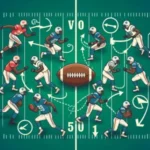
Becoming an elite wide receiver requires more than raw speed. While your 40-yard dash time might get you noticed, your ability to process defensive schemes and execute mechanical tasks under pressure keeps you on the field. Think of the position as a game of chess played at high velocity: your physical traits are the pieces, but your technique is the strategy.
The Art of the Release: Winning the First Three Yards
Credit : whatcanu.com
The success of your route is determined within the first three yards off the line of scrimmage. If you lose the initial battle against a defensive back, you are effectively playing catch-up for the remainder of the play. Treat your release like a professional sprinter exiting the blocks: every movement must be intentional and explosive.
Maintain a Neutral Stance: Avoid leaning or shifting weight before the snap. A balanced, athletic stance allows you to break in any direction without alerting the defender. If you shift your weight, the cornerback will read your intent before you even move.
Hand Fighting as a Tool: Use your hands to disrupt the defender’s path. Treat your arms like shock absorbers; keep them inside the defender’s shoulder pads to prevent them from pinning you to the sideline.
The Power Step: Avoid taking long, loopy strides at the start. These waste precious milliseconds. Focus on a violent, short punch into the turf to drive your body forward with maximum force immediately.
Route Precision: Geometric Efficiency
Elite route running is essentially geometry performed at full speed. Your goal is to manipulate the defender’s center of gravity to create a window for your quarterback. Even the fastest athletes fail if they run aimlessly. You must run every route with identical intensity to maintain the integrity of your deceptive movements.
Consistent Tempo: If you only run hard when you are the primary target, the defense will identify your decoys easily. Keep your head and shoulders neutral to prevent tipping your route breaks to the defensive back.
The Break Point Hinge: To execute a sharp cut, you must lower your center of gravity. Think of your plant leg like a heavy-duty door hinge. If the hinge is loose or poorly placed, the door fails to swing cleanly. Plant your foot hard and lean into the cut to ensure you change direction without losing momentum.
Variable Speed Control: The best receivers use acceleration and deceleration to disrupt the defender’s rhythm. By slowing down momentarily, you force the defensive back to stop their feet, creating an immediate gap when you explode back into your full sprint.
Advanced Catching Mechanics: Securing the Football
Credit : whatcanu.com
Catching is a process that begins long before the ball reaches your hands. If your mind is on the incoming hit, you have already dropped the pass. Your focus must be entirely on tracking the ball’s trajectory, treating your hands like a magnet for the leather.
The Diamond Technique: For passes above your chest, form a diamond with your thumbs and index fingers. This creates a stable, padded pocket. Imagine your hands are a basketball hoop; the ball should settle securely into the net before you attempt to move upfield.
Visual Lockdown: Never look upfield before the ball is securely in your grip. This is a common error among young players who are overeager to gain yards after the catch. Treat the ball like a baseball coming into a glove; track it all the way to the tuck point.
High-Point Mastery: Do not wait for the ball to descend. Reach up and snatch it at the highest possible point. This minimizes the defender’s chance to knock the ball away from beneath you at the last possible second.
Reading the Defense: Cognitive Processing
You cannot be a passive participant on the field. You must analyze defensive schemes pre-snap to identify where the open space—the dead air—will exist. If you understand the defense, you know where to be before the ball is even snapped.
Man-to-Man Awareness: When facing tight press coverage, focus on winning your leverage. If the defender plays outside shade, they are daring you to take the inside lane. Use your footwork to cross their face, effectively putting your body between them and the path of the ball.
Zone Recognition: Against zone coverage, your strategy shifts entirely. Do not try to outrun the defender. Identify the gap between two zone defenders, sit in that window, and become a stationary, reliable target for your quarterback.
Film Study: Use your practice tape to identify defensive tells. Cornerbacks often shift their weight toward the sideline or change their stance slightly before specific coverage adjustments. Recognizing these micro-cues allows you to adjust your route on the fly.
Field Reality: Mistakes to Avoid
Credit : whatcanu.com
Small technical flaws often lead to the most frustrating failures on game day. Avoid these three common traps to keep your performance at a professional level:
Eliminate Rounded Cuts: A rounded cut is a losing cut. If you fail to make sharp, crisp angles, the defender will stay in your hip pocket. Force yourself to plant your outside foot firmly to ensure a clean break every time.
Stop Telegraphing: Never tip your route with your eyes or shoulders. Use your eyes to look one way while your feet carry you in another, similar to a basketball crossover dribble.
Finish Through Contact: The play does not end when you secure the catch. Turn your shoulders square to the defender immediately. Churn your legs through the contact point rather than attempting to dance your way out of every tackle.
Mastery comes from repetition until these mechanics become muscle memory. When your technique is automatic, you stop thinking about how to run the route and start focusing entirely on dominating the opponent. Keep your drills consistent, track your progress on film, and always prioritize the fundamentals over flashiness.