
Mastering the Physics and Technique of the Perfect Tackle

Tackling in American football is the primary defensive tool for stopping offensive progress. It is not about simply hitting an opponent; it is about controlling the physics of a collision to bring a ball carrier to the ground safely and efficiently. If you visualize the tackle as a transfer of energy, you realize that your body acts as a spring: you must store potential energy in your legs and release it through a controlled point of contact.
The Mechanical Foundation: The Breakdown
Before you ever make contact, you must master the “breakdown.” This is the transition from a sprint to a controlled, athletic stance. Imagine yourself as a car braking before a sharp turn; you must shorten your steps, lower your hips, and widen your base to maintain balance. If you remain tall, you become a pendulum that is easily knocked off center by the momentum of the ball carrier.
- Lower your center of gravity: Bend at the knees, not the waist, to keep your power base stable.
- Shorten your strides: This allows you to adjust to the ball carrier’s sharp lateral cuts without overcommitting.
- Keep your eyes on the target: Lock your vision on the numbers or the belt buckle of the ball carrier to track their movement accurately.
Point of Contact: The Shoulder Drive
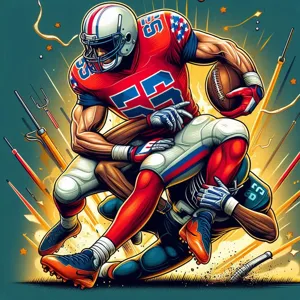
Modern coaching emphasizes the “shoulder tackle.” Leading with the helmet is both dangerous and technically inefficient. By using the thickest part of your shoulder (the deltoid area), you create a stable surface for impact. Think of it like a battering ram; if you lead with the head, you risk spinal injury and lose your visual tracking of the target.
Upon contact, your legs must continue to drive. Many defenders make the mistake of stopping their feet the moment they hit the opponent. You are like a piston engine; the contact is just the beginning. The “drive” phase is where you push through the ball carrier, using your leg strength to finish the play while the opponent’s momentum is still neutralized.
The Wrap-and-Drive Technique
The wrap is your insurance policy. If you hit without wrapping, you are essentially gambling on the force of the impact to stop the player. If you miss the direct center, they bounce off you. Your arms should act like a clamp, securing the ball carrier’s thighs or hips.
- The Scoop: As you initiate contact, bring your arms around the opponent’s thighs, effectively scooping them upward.
- The Squeeze: Pull the ball carrier toward your chest, removing any space between your bodies.
- The Finish: Drag your feet through the ground, turning the energy into a downward force that dumps the ball carrier to the turf.
Field Awareness and Tactical Timing

Timing is a mental game. If you commit to a tackle too early, a savvy runner will simply sidestep you. If you commit too late, they gain extra yardage. You must read the “triangle” of the play: the ball carrier’s speed, the sideline, and the location of your teammates.
Error to avoid: The “all-or-nothing” dive. Novice players often launch their bodies horizontally at the runner. Unless you are in a goal-line stand with no other options, never leave your feet. If you miss a diving tackle, you are out of the play completely. Stay on your feet and “track the near hip” of the runner until you are close enough to initiate the drive.
Training Your Muscle Memory

Practical application requires consistent repetition. Use these drills to build the instinctual reactions needed during a chaotic game scenario:
- The Wall Drill: Practice the shoulder-to-pad connection against a stationary pad held by a teammate. This forces you to focus on head placement and hip position rather than the fear of the impact.
- The Circle Drill: Set up a small circle and have a ball carrier attempt to dodge you. This trains your “breakdown” and lateral agility.
- The Wrap-up Focus: Use a tackling dummy and focus solely on the hand placement behind the knees. Ensuring your hands are low is the key to preventing the runner from spinning out of your reach.
The Mental Side: Aggression vs. Composure
High-level tackling requires controlled aggression. When you become too emotionally charged, you lose your precision. Think of yourself as a hunter; you must stay calm and calculated until the exact moment of impact. If you feel your breathing become shallow or your vision narrowing, take a split second to reset your focus. A calm defender makes fewer mistakes than an overly aggressive one.
Remember, the goal is to make the tackle without becoming a liability. By prioritizing sound mechanics—low hips, eyes up, and the explosive drive—you transform from a player who relies on luck into a reliable defensive asset. Consistent practice of these fundamentals will translate into more stops, fewer missed tackles, and a significantly higher impact on your team’s defensive performance.
Content updated on 2026-08-27