How Motorbike Transmissions Function
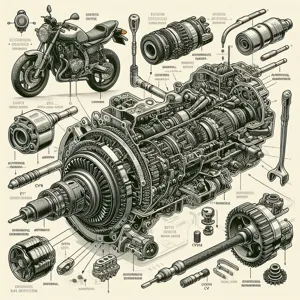
Your motorcycle transmission acts as a torque converter between the engine crankshaft and the rear wheel. Think of it like a gear system on a bicycle. By selecting different gear ratios, you manage the trade-off between pulling power at low speeds and high-speed efficiency on straight roads. Understanding these mechanics helps you optimize performance and avoid costly repairs.
Manual Transmissions: Mechanical Precision
Most performance and touring motorcycles utilize a constant-mesh manual transmission. You operate this via a hand-clutch and a foot-lever. This provides a direct mechanical link between the engine and the rear wheel. It allows you to control the exact moment power reaches the tire.
- Clutch Control: You manage the engine-to-transmission coupling. This allows you to ‘slip’ the clutch during slow-speed maneuvers to maintain balance without stalling.
- Engagement Mechanics: Shifting involves moving ‘dogs’ on sliding gears into slots on fixed gears. A crisp, deliberate kick on the shifter ensures these dogs fully seat, preventing rounded edges.
- Maintenance Reality: If you ride a bike with a wet clutch, the clutch plates soak in the same oil as your engine. Use only JASO-MA rated motorcycle oil. Automotive oils contain friction modifiers that will cause your clutch to slip under high torque loads.
Continuously Variable Transmission (CVT)
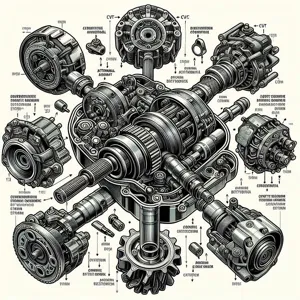
Found primarily on scooters and some maxi-scooters, a CVT eliminates fixed gear ratios. It uses a V-shaped belt running between two pulleys that change diameter as engine RPM rises. Imagine a bicycle where the chainrings could change size while you pedal; the engine stays at its peak power band without the interruption of gear shifts. It offers perfectly linear acceleration but lacks the engine braking capabilities of a manual setup.
Dual-Clutch Transmission (DCT)
Popularized by Honda, the DCT is an automated manual. It houses two separate clutches: one for odd-numbered gears and one for even. When you are in first gear, the computer has already engaged the second gear on the secondary clutch shaft. At the shift point, the system instantly swaps clutch engagement. It is technically superior to a human for rapid, seamless shifting, providing the efficiency of a manual with the ease of an automatic.
Semi-Automatic Systems
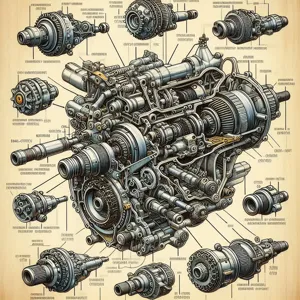
Semi-automatic transmissions use electronic actuators to handle the clutch engagement for you. You trigger the gear change via handlebar buttons or a foot lever. You retain the tactical satisfaction of choosing your gear, but the bike handles the synchronization. It is an ideal middle ground for riders who struggle with left-hand fatigue in heavy stop-and-go traffic.
Final Drive Systems: The Last Mile
The final drive transfers the power from the gearbox to the rear wheel. Each system changes how the bike handles.
- Chain Drive: The industry standard for performance. It is lightweight and offers the least power loss. However, it requires cleaning and lubrication every 300 to 500 miles. Neglecting this leads to accelerated sprocket wear and chain stretch.
- Shaft Drive: An enclosed gear-driven system. It is maintenance-free for thousands of miles. The trade-off is higher unsprung weight and a ‘jacking’ effect, where the rear suspension compresses or extends during aggressive throttle changes.
- Belt Drive: Common on heavy cruisers. These operate quietly and require zero lubrication. They are extremely durable but cannot be adjusted or repaired easily on the side of the road if a rock punctures the belt.
Preventing Transmission Failure
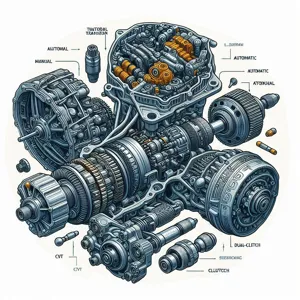
Transmission issues rarely appear suddenly. They are usually the result of mechanical neglect. Listen for ‘clunking’ or ‘whining’ noises during gear engagement, as these are primary indicators of internal wear.
- The False Neutral: This occurs when a shift is not completed fully, landing the gearbox between two gears. Avoid this by using a firm, positive movement on the shifter. Repeated false neutrals cause significant damage to the gear dogs.
- Chain Tension: Check your chain slack every two weeks. A chain that is too tight places excessive stress on the transmission output shaft bearing, leading to expensive seal failures and oil leaks.
- Temperature Management: Heavy city traffic generates immense heat in a transmission. If your bike has a manual clutch, avoid ‘holding’ it at stoplights in first gear. Always shift to neutral to allow the clutch pack to cool.
Choosing the Best Transmission for Your Riding Style
Your choice should be dictated by your specific riding environment rather than current trends.
- For Urban Commuters: Choose a DCT or CVT. Removing the need for constant clutch modulation reduces rider fatigue and makes navigating gridlock significantly safer.
- For Sport and Track Riders: Stick to a manual transmission. You need to control engine braking and precisely manage torque delivery while leaned over in a corner, which only a manual allows.
- For Adventure and Long-Distance Touring: A shaft drive is the professional choice. Reliability far outweighs the slight weight penalty when you are hundreds of miles from a service center.
Content updated on 2026-09-09