
What are the best motorbike riding techniques for beginners?

Learning to ride is not just about passing a test; it is about building a mechanical sympathy with your machine. Beginners often focus too much on speed, but the real secret to safety lies in mastering low-speed balance and weight management. Treat your motorcycle as an extension of your own body, not a separate vehicle you are simply sitting on top of.
Mastering low-speed control via the friction zone
Most beginners stall at traffic lights because they treat the clutch as an on-off switch. The clutch is actually a bridge between your engine and the rear wheel. The friction zone is that narrow lever movement where the engine power starts to reach the wheel.
- The Practice: In a flat parking lot, sit on the bike with the engine running in first gear. Slowly release the clutch until you feel the bike want to pull forward. Pull it back in immediately. Repeat this 50 times until your muscle memory masters the engagement point.
- Pro Tip: Keep your rear brake slightly pressed during these slow-speed maneuvers. This keeps the chassis tensioned and prevents the bike from feeling jerky or unstable at walking speeds.
The logic of countersteering
Many new riders believe you turn a bike by turning the handlebars, but physics disagrees. Above 15 mph, you must use countersteering to initiate a turn. Pushing the handlebar forward on the side you want to go is the only way to tip the bike into a corner.
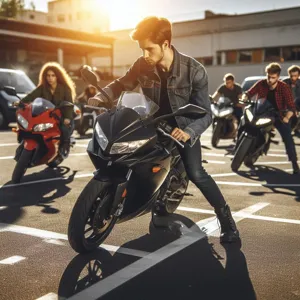
If you want to turn left, push the left handlebar forward. It feels wrong at first, but it works every time. Think of it like this: the front wheel is a gyroscope. By pushing the bar, you disrupt the balance and force the bike to lean. Never try to lean by just shifting your weight; it is too slow for emergency maneuvers.
Vision: The eyes dictate the path
Your bike will always track exactly where you are looking. If you fixate on a pothole, you will hit it. This is called target fixation. It is a psychological trap where your brain focuses on a hazard and your muscles inadvertently guide the bike toward it.
Force yourself to look through the turn, specifically toward the exit point. When you approach a curve, turn your entire chin toward the direction you want to go. This forces your shoulders to align and naturally guides the bike through the arc of the turn.
Braking with precision

The front brake is your primary tool for stopping, accounting for roughly 70% of your power. Do not grab it like a panicked reflex. Grabbing the front brake causes the forks to dive and can lock the front wheel, leading to a front-end wash-out.
Use a two-finger approach initially to prevent over-braking. Squeeze the lever progressively, like you are squeezing a trigger to clear the slack before firing. As the weight shifts forward, you can gradually increase the pressure. Always finish your braking before you lean the bike into a corner.
Field-tested habits to prevent common crashes
Experience is the best teacher, but these specific mistakes happen to almost every beginner. Avoiding them will save you from common low-side incidents:
- Do not trail-brake in the rain: Applying the front brake while leaned over on wet pavement is a recipe for a slide. Do your braking while the bike is upright.
- The lane position trap: Never ride in the center of the lane. This is the ‘oil strip’ where vehicles leak fluids and debris settles. Stay in the left or right tire track to maintain better traction and stay visible.
- Cover your controls: Always keep two fingers on the front brake lever when approaching intersections. This saves crucial milliseconds if a car pulls out in front of you.
The importance of the ‘Ghost’ mindset

Assume every car on the road is blind to you. Do not rely on eye contact with drivers, as they often look right through motorcyclists. If you are approaching an intersection, watch the front wheels of cars waiting to turn. The wheels reveal movement before the car body does.
Always maintain a three-second following distance. This provides a buffer zone for reaction. If the road is wet, double that distance immediately. Your braking distance increases exponentially as road grip decreases, and you cannot afford to out-ride your vision.
Establishing a pre-ride protocol
Before you even put your helmet on, walk around the bike. Check the tire pressure at least once a week; a low tire will make the bike feel heavy and unresponsive in corners. Check the chain tension; a loose chain can slap the frame and ruin your power delivery.
Riding is a high-focus activity. If you are tired, angry, or distracted, the bike will amplify your mistakes. Treat your pre-ride check as a mental warm-up to transition from your daily life into the focus required for riding.
Contenu mis a jour le 2026-08-23