Elevating Your Basketball IQ: Beyond Basic Strategy

Basketball is a high-speed game of physics and geometry. If you view the court as a simple grid, you will quickly realize that winning comes down to manipulating space. Many players and coaches rely on generic YouTube highlights, but that is like trying to learn architecture by looking at photos of houses. You need to understand the structural load and the foundation beneath the surface.
Developing a high-level strategic mind requires moving from passive observation to active analysis. You must learn to deconstruct how defensive rotations, spacing, and transition timing dictate the outcome of a possession. This guide identifies the professional-grade resources that actually move the needle on your basketball intelligence.
The Best Data-Driven Resources for Tactical Growth

To stop guessing, you need evidence. These tools provide the raw data required to build a repeatable and successful system.
- Synergy Sports: This is the industry standard for pro-level scouting. Think of Synergy as a filter for the game; it allows you to isolate every single ‘pick-and-roll’ or ‘post-up’ play from a season. You can see how a specific defense reacts to these sets, which allows you to predict outcomes rather than reacting to them.
- Thinking Basketball (Ben Taylor): Most analysts talk about who scored, but Taylor talks about why. His work is essential for understanding ‘gravity’—the concept that a great shooter acts like a magnet, pulling defenders away from the basket to create vacuum spaces for teammates. Learning this is like learning to read the invisible currents in water.
- FastModel Sports (FastDraw): If you want to design plays, stop using pen and paper. FastDraw is the software used by NBA and NCAA coaches to diagram sets. Using it forces you to account for player spacing and timing. It turns an abstract idea into a concrete visual plan that your players can actually execute.
- The Basketball Coach’s Association (NABC) Archives: This resource provides peer-reviewed clinics. You get access to the actual playbooks of successful college coaches. These aren’t just diagrams; they include the coaching points, the ‘if-then’ scenarios, and the defensive adjustments for when a play is scouted and stopped.
Avoiding the Trap of Over-Complexity
A classic error among developing coaches is the ‘Playbook Bloat.’ You might want to run thirty different offensive sets to look sophisticated. In reality, you are just causing confusion for your players. If a player has to think about the play, they have already lost their split-second advantage.

Think of your offense like a limited menu at a high-end restaurant. It is far better to have four dishes you cook perfectly than fifty dishes that are mediocre. Your goal should be mastery of three base sets that can be morphed based on how the defense decides to play you. If the defense switches, your base set should have a built-in counter that requires no new play call.
The 0.5 Second Rule: Improving Decision Making
One of the most effective tactical shifts you can implement is the ‘0.5 basketball’ philosophy. The best offenses in the world operate on a rule: every player must decide to shoot, pass, or drive within 0.5 seconds of catching the ball. This keeps the defense in a constant state of panic and reaction.
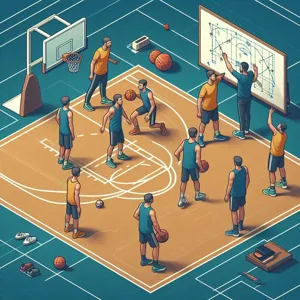
If you hold the ball for two seconds, you allow the defense to recover their alignment. A defense is like a rubber band; if you move the ball instantly, you keep it stretched to the breaking point. If you hold it, the rubber band snaps back to its neutral, strong position. To train this, use a stopwatch during practice drills. If a player holds the ball longer than half a second, the possession ends.
Field Notes: How to Build Your Personal Playbook
Your playbook should be a living document, not a static binder. Here is how to keep it functional for real-world application:
- The ‘Read’ is Everything: A play without a ‘read’ is just a drill. For every offensive set, write down the primary option, but always add a secondary ‘if they do this, we do that’ contingency.
- Post-Game Audits: After every game, review the film specifically for one failure. Did your spacing break down on a corner three? Was your point guard pressured into a bad angle? Document the specific moment the breakdown occurred.
- Simulated Pressure: In practice, run your plays against a ‘live’ defense that is allowed to scout you. If your team cannot execute the play when the opponent knows what is coming, the play is too complex or lacks a proper counter.
By shifting your focus toward these analytical tools and tactical philosophies, you stop being a fan and start being a student of the game. Efficiency in basketball is not about working harder on the court; it is about working smarter by leveraging data and refined decision-making processes.
Content updated on 2026-09-13