Understanding the Core Difference Between Saving and Investing
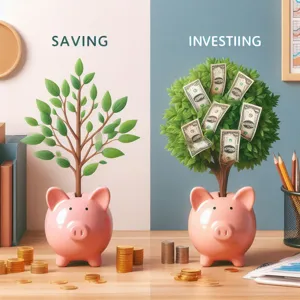
Most people use the terms saving and investing interchangeably, but they are fundamentally different financial behaviors. Think of saving as a bunker and investing as an engine. You need the bunker for protection during a storm, but you need the engine if you actually want to travel somewhere. Confusing the two is a common mistake that can either leave you vulnerable to emergencies or cause your wealth to stagnate against inflation.
What is Saving? The Foundation of Financial Safety
Saving is the act of setting aside money for a specific purpose, usually within a short timeframe. Your primary priority here is capital preservation. You aren’t looking for a high return; you are looking for 100% certainty that the money will be there when you need it.
- Liquidity: Your money must be accessible instantly. If you need it today, you shouldn’t have to sell an asset to get it.
- Low Risk: The goal is to avoid losing a single penny of your principal.
- Typical Tools: High-yield savings accounts, money market accounts, or short-term Certificates of Deposit (CDs).

Common mistake to avoid: Many people leave large sums of cash sitting in a standard checking account that earns 0.01% interest. Your savings should always be in a vehicle that at least tries to keep pace with the market, but never one that risks the principal.
What is Investing? The Engine for Long-Term Growth
Investing is the process of putting capital into assets with the expectation of generating a profit. Unlike saving, you are accepting the risk of short-term price fluctuations in exchange for the long-term benefit of compounding growth.
Compounding is best explained as a snowball rolling down a hill. Initially, it grows slowly as it picks up a thin layer of snow. Over time, that mass increases exponentially. In finance, this means your returns start earning their own returns.
- Higher Risk: The market can go down, and the value of your assets can temporarily drop below what you paid for them.
- Time Horizon: This is a long-term game, typically for goals five, ten, or thirty years away.
- Typical Tools: Stock index funds, ETFs, diversified portfolios, or real estate holdings.
The Inflation Trap: Why Savings Alone Lose Money
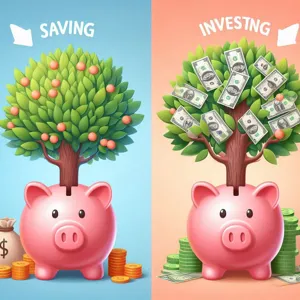
If you keep all your money in a savings account, you might feel safe, but you are quietly losing purchasing power. Inflation is the hidden tax that raises the cost of goods every year. If inflation is at 3% and your savings account earns 1%, you are losing 2% of your wealth’s value annually. Investing is the only reliable way to outpace this erosion over a multi-decade timeline.
Establishing Your Personal Financial Hierarchy
Do not attempt to invest until you have mastered the basics of saving. Follow this order of operations to ensure you aren’t gambling with money you can’t afford to lose:
- The Emergency Fund: Set aside 3-6 months of essential living expenses. This is non-negotiable and must stay in a liquid, high-yield savings account.
- Eliminate High-Interest Debt: If you have credit card debt at 20% interest, paying that off is a guaranteed 20% return. Do this before investing.
- Start Investing: Once the safety net is built and toxic debt is cleared, funnel your surplus income into growth assets to build long-term wealth.
Return on Experience: Lessons from the Field
The most common failure I see is the ‘Panic Sell.’ Investors put money into the market, and when the economy dips, they get scared and pull their money out, effectively turning a temporary market fluctuation into a permanent loss. If you find yourself losing sleep over market drops, you have likely invested too aggressively for your personality. Adjust your allocation to include more bonds or savings, but never abandon your long-term investment strategy entirely.
How to Choose Your Strategy
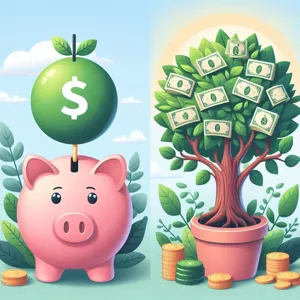
Your strategy should be dictated by your ‘Time Horizon.’ This is simply the countdown clock to when you need the cash.
- 0-3 Years (Save): If you are saving for a wedding, a down payment, or a new car, keep the money in savings. You cannot afford market volatility.
- 5+ Years (Invest): If you are saving for retirement or a child’s education, you have the luxury of time. You can afford to stay in the market through cycles of highs and lows.
Actionable Tip: Automate your contributions. Set up a direct transfer from your paycheck to your savings account and another to your investment account. When it happens automatically, you remove the emotional element of deciding whether to save or invest each month.
Conclusion: Balance is Your Best Ally
There is no single ‘right’ answer between saving and investing; there is only the right balance for your current life stage. Use savings to provide the foundation that allows you to take calculated risks in the market. By keeping your emergency fund separate from your long-term investments, you ensure that you are never forced to sell stocks during a market downturn just to pay an unexpected bill. Focus on building that safety net first, then let the power of compounding do the heavy lifting for your future.
Contenu mis a jour le 2026-08-22