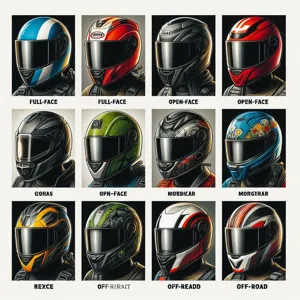
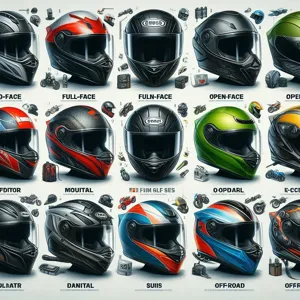
Understanding the Different Types of Motorbike Helmets
Credit : whatcanu.com
Choosing the right helmet is the most significant decision you will make as a rider. It is not just about aesthetics; it is a critical piece of engineering designed to protect your most vital asset. A poor fit or the wrong type of helmet can be as dangerous as riding without one. This guide will walk you through the technical differences between helmet styles to help you find the best match for your riding needs.
The Core Categories of Motorbike Helmets
Helmets are categorized by how much of the head they cover. Each category offers a specific trade-off between ventilation, weight, and impact protection.
Full-Face Helmets
These are the gold standard for safety. A full-face helmet covers your entire head and base of the skull, including a fixed chin bar. Think of it like a reinforced shell for your head. Why choose it? It offers the best protection against impact and weather. It is also significantly quieter than other styles, which reduces fatigue on long highway rides.
Modular (Flip-Up) Helmets
Credit : whatcanu.com
Modular helmets provide the structural benefits of a full-face helmet with the convenience of an open-face style. The entire chin bar pivots upward. This is perfect for touring riders who frequently stop to pay tolls or communicate with others without removing their gear. Pro tip: Always check that your modular helmet is ‘P/J’ certified, which means it is legally safe to ride with the chin bar in the open position if desired.
Open-Face (Three-Quarter) Helmets
These cover the top, back, and sides of your head but leave your face exposed. They are popular for urban commuting and retro-styled riding. While they provide excellent peripheral vision and airflow, they leave your chin and jaw vulnerable in a crash. If you choose this style, ensure you wear high-quality eyewear to prevent wind and debris from blinding you.
Half Helmets (Beanies)
These offer the bare minimum of coverage. They protect only the top of the head. While they offer the most freedom, they provide virtually no protection for the face or the base of the skull. As a professional, I recommend reserving these only for very slow-speed, short-distance trips in non-hazardous environments.
Dual-Sport and Off-Road Helmets
Credit : whatcanu.com
Dual-sport helmets look like a cross between a motocross helmet and a street helmet. They feature a peak (visor) for sun protection and an extended chin bar for ventilation. If you ride an adventure bike on both pavement and dirt, this is your best option. Motocross-specific helmets should be paired with goggles, as they lack an integrated face shield.
Key Technical Features to Evaluate
Don’t be swayed by graphics alone. Focus on these technical pillars to judge the quality of a helmet.
Safety Certifications: Look for ECE 22.06 (the latest European standard) or Snell M2020. These are more rigorous than the baseline DOT standard.
Shell Composition: Entry-level helmets use polycarbonate. Mid-to-high-end helmets use fiberglass, carbon fiber, or composite weaves. Carbon fiber is lighter, which significantly reduces neck strain over time.
Retention Systems: A double D-ring strap is the industry standard for security because it cannot be adjusted incorrectly. Ratcheting quick-release buckles are more convenient but must be checked for wear.
Ventilation Logic: Look for an ‘EPS channel’ system. This means the interior foam has grooves molded into it that allow air to travel from the intake vents across the top of your head to the exhaust vents.
How to Find Your Perfect Fit
A helmet that is too large is useless in a crash. A helmet that is too small will cause painful pressure points that make you want to stop riding. Follow this process to get the right size:
Measure: Wrap a cloth tape measure around your head, about one inch above your eyebrows.
Consult the Chart: Every brand has a different ‘internal shape’ (Intermediate Oval, Long Oval, etc.). If you have a long head but buy a round-shaped helmet, you will have gaps at the temples.
The Shake Test: Put the helmet on and fasten the strap. Grasp the helmet and try to move it side to side. Your skin on your cheeks should move with the helmet. If the helmet slides over your skin, it is too big.
The Pressure Point Check: Wear the helmet for 15 minutes at home. If you develop a ‘hot spot’ (a painful pressure point) on your forehead, the shell shape is wrong for your head.
Common Mistakes and Real-World Advice
Credit : whatcanu.com
The ‘Break-in’ Myth: A new helmet should be snug. The cheek pads will compress by about 15-20% after 20 hours of use. Do not buy a helmet that feels ‘comfortable’ immediately in the store, as it will likely become too loose once the padding breaks in.
Replacement Cycles: You must replace your helmet every 5 years, even if it hasn’t been in a crash. The EPS foam liner (the part that absorbs impact) degrades and becomes brittle over time due to sweat, heat, and hair oils. Additionally, if you drop your helmet on a hard surface from waist height, the internal structure may be compromised. Replace it.
Noise Management: If you are frustrated by wind noise, the issue is often the gap at the neck, not the helmet itself. A ‘chin curtain’—a piece of fabric that blocks air from entering under the chin bar—can reduce noise levels by up to 50% on almost any full-face helmet.