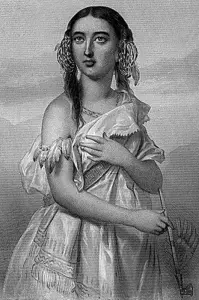
The first Native American person to be honored on a United States postage stamp was Pocahontas. Her portrait appeared on a 5-cent stamp issued in 1907 for the Jamestown Exposition, which marked the 300th anniversary of the founding of Jamestown, Virginia.
The 1907 Jamestown issue
The Jamestown Exposition series had three stamps:
- 1 cent: Captain John Smith;
- 2 cents: the founding of Jamestown;
- 5 cents: Pocahontas.
The portrait of Pocahontas was based on a 1616 engraving by Simon van de Passe, made when she visited England. Because it was issued in smaller numbers and was used mostly for heavier mail, the 5-cent stamp is the most sought-after of the set among collectors.
Who was Pocahontas?
Pocahontas (also known as Matoaka, and later Rebecca) was the daughter of Powhatan, the leader of an alliance of Algonquian-speaking peoples in Virginia. She was captured by the English in 1613, converted to Christianity, married the colonist John Rolfe in 1614 and traveled to England, where she died in 1617. Many popular stories about her, including the famous rescue of John Smith, are debated by historians.
Earlier images of Native Americans
Native Americans appeared on US stamps before 1907, but not as named individuals. The 1869 pictorial issue and the 1898 Trans-Mississippi issue, for example, included scenes such as “Indian Hunting Buffalo”.
Later honorees
Many Native American individuals have since appeared on US stamps, including:
- Sequoyah, creator of the Cherokee syllabary (1980);
- Crazy Horse, Lakota leader, in the Great Americans series (1982);
- Jim Thorpe, Olympic champion and football player (1984);
- Sacagawea, in the Legends of the West series (1994);
- Maria Tallchief, ballerina, in American Ballerinas (2004);
- Mary Golda Ross, aerospace engineer (2019).
Collecting tips
The Smithsonian’s National Postal Museum has online collections and exhibits on stamp history and on the representation of Native Americans in postal history. Collectors should look at condition, centering and perforations, and buy valuable stamps with expert certification.
For other quick history and culture questions, see woman vs. women.