Can We Ever Truly Escape the Influence of Classic Films?

You likely view your life as a series of autonomous decisions. You believe your romantic standards, career goals, and ethical framework belong exclusively to you. In reality, you are operating on a cultural software installed long before you were born. Classic cinema acts as the invisible operating system of modern life, dictating how you perceive conflict, success, and love.
Escaping this influence is not about avoiding movies. It is about identifying the source code. When you recognize that your expectations for a healthy relationship or a leadership role mirror a 1950s screenplay, you shift from being a passive character to the director of your own life.
The Neural Economics of Storytelling
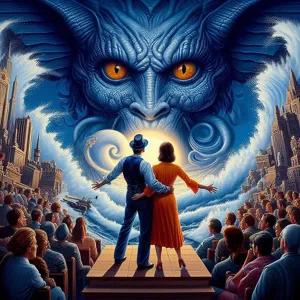
Your brain is a high-performance machine optimized for energy efficiency. It treats uncertainty as a threat. To save cognitive bandwidth, your mind relies on mental shortcuts called heuristics. Classic cinema perfected these shortcuts through archetypes. By watching these films, your brain learned to categorize complex human behavior into simple binary labels like hero or villain within milliseconds.
Cognitive Anchoring Explained
Think of cognitive anchoring like a fixed bookmark in a textbook. Your brain sets a reference point based on established film tropes. When you meet a new person, your brain compares them to these archetypes to save processing power. It is much easier to label a colleague as a cynical mentor than to observe the messy nuances of their actual personality. While this shortcut is fast, it is mathematically inaccurate because it ignores 90% of the individual’s reality.
The Recursive Loop of Modern Media
You might claim that you avoid old movies to stay immune. This is a technical error. Modern streaming platforms and blockbuster films are built on a recursive loop. Every current rom-com or action thriller is a remix of a Golden Age original. You are still consuming the same core patterns, simply repackaged with faster editing and modern special effects. You are not watching a new story; you are consuming a high-definition update of a historical narrative.
The Scripting of Your Personal Life

Many of your life decisions are subconsciously scripted to mirror the resolution arcs seen on screen. We engage in a form of psychological osmosis, absorbing behavioral patterns from cinema and projecting them onto our daily existence. This creates a friction between your actual life and your manufactured expectations.
The Cinematic Dating Trap
Many people expect their romantic lives to mirror the dramatic tension of a 1940s classic. They crave intense, high-stakes revelations and grand gestures. In reality, healthy relationships are built on mundane stability and boring consistency. When you demand the cinematic fire of a Hollywood script in your real life, you are attempting to film a high-budget scene in a low-budget, real-world setting. This leads to chronic dissatisfaction with perfectly functioning partnerships.
The Leadership Illusion
Professional expectations often fall into the same trap. Many employees seek a leader who displays fictional stoicism and moral perfection. This is an impossible benchmark. Real-world leadership requires constant, messy compromises and pivoting under pressure. Judging your actual manager against a script-writer’s idealized creation guarantees professional burnout and a lack of constructive engagement.
Common Pitfalls and Field Observations

You may believe your fashion or aesthetic preferences are unique. They are usually filtered through decades of visual conditioning. Marketing agencies use these cinematic triggers to sell you products.
- The Nostalgia Trap: High-end brands use the high-contrast lighting of film noir in advertisements. Your brain associates this lighting with status and mystery, prompting a purchase based on a sub-conscious cinematic memory rather than product quality.
- The Error of Uniqueness: Believing your aesthetic choices are original is a common cognitive bias. Most trends are cyclical, returning to a visual vocabulary popularized by mid-century icons.
- The Confirmation Feedback Loop: Consuming content that reinforces your current biases strengthens existing neural pathways. This makes it progressively harder to observe the world as it actually is, rather than as a movie.
How to Debug Your Cultural Software
You do not need to abandon your love for cinema. You simply need to change your relationship with it. Treat films as historical documents rather than instruction manuals for your life.
- Deconstruct the Formula: Watch a classic movie with a notebook. Identify the tropes as they appear. Labeling the hero’s journey or the love-triangle subplot turns an emotional, immersive experience into an objective, technical one.
- Diversify Your Input: Pair every Hollywood classic with a film from a different culture or era. This breaks the monoculture of your cinematic diet and introduces you to alternative, non-Western methods of resolving conflict.
- Audit Your Reactions: The next time a movie makes you feel a profound sense of justice or romance, pause. Ask yourself: Is this feeling an organic reaction to this specific situation, or am I reacting to a conditioned cinematic reflex?
Classic films are pillars of our cultural history. However, a pillar is designed to hold up a structure, not to act as a cage for your decision-making. By acknowledging the influence of these films, you reclaim the power to define your own reality. Stop letting a screenwriter from 1955 dictate your future.
Content updated on 2026-10-10