How Does Cinema Explore the Human Condition?

Cinema serves as a high-fidelity laboratory for human behavior. Think of a film not as a story, but as a controlled experiment where variables like greed, fear, or love are isolated under pressure. When you watch a protagonist navigate a crisis, you are running a simulation that helps you calibrate your own moral compass.
To stop viewing films as passive entertainment, you must treat them as diagnostic tools. You need to analyze the mechanics of character evolution to uncover what makes us tick. Here is how you can use cinema to decode the complexity of being human.
The Anatomy of Existential Conflict
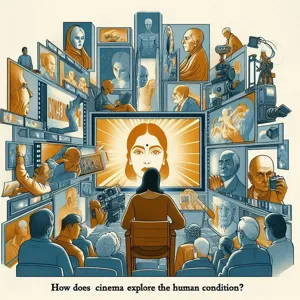
Great storytelling thrives on conflict, which is essentially the friction between an individual and their environment. When you look beyond the plot, you see recurring patterns of human struggle that mirror your own reality.
- The Illusion of Autonomy: We often believe we are masters of our destiny until reality proves otherwise. Consider The Deer Hunter. The characters believe their small-town bonds are impenetrable, only to be shattered by the chaos of war. It teaches you that some forces are larger than individual will.
- The Cost of Social Masking: Humans are performative. We adopt roles to survive in social hierarchies. In The Master, the tension between the protagonist’s raw impulses and the rigid structure of a cult reveals the exhausting nature of trying to fit into a mold that does not suit you.
- The Paradox of Memory: We define ourselves by what we remember. Films like Aftersun illustrate how our perceptions of the past are filtered through the lens of our current limitations. It demonstrates that understanding the human condition requires acknowledging that our personal history is a selective, often unreliable, narrative.
Field Analysis: The Three-Stage Behavioral Audit
Most viewers finish a movie and simply ask if they enjoyed it. This is a missed opportunity. Instead, conduct a post-viewing audit to extract actionable insights from the character arcs. Use this process to identify patterns in behavior.
- The Root Belief: Identify the core misconception the character holds at the beginning. In Nightcrawler, the lead believes that personal success justifies any violation of ethical boundaries.
- The Catalyst for Entropy: Pinpoint the moment when the character’s internal logic fails. This is rarely a single event; it is usually a compounding series of choices. In The Social Network, look for the moment Mark Zuckerberg chooses professional triumph over genuine human connection.
- The Self-Correction Loop: Compare the character’s failure to your own decision-making habits. If you were in their situation, at what point would your own biases have triggered a similar mistake? This prevents you from viewing characters as villains and instead helps you see them as warnings.
The Technical Mechanics of Emotional Manipulation

Directors use technical parameters to trigger your biological responses. If you do not understand these, you are essentially letting a filmmaker remote-control your empathy. This is similar to a magician using sleight of hand; once you see the trick, the illusion remains powerful, but you are no longer deceived by it.
Consider the use of negative space. In Manchester by the Sea, the director uses vast, empty landscapes to mirror the character’s internal isolation. When the frame feels barren, you feel the character’s grief physically. Recognize that every camera angle is a subjective choice designed to make you feel a specific emotion. When you see a low-angle shot, the director is telling you who holds the power in that room. When you see a tight close-up, they are forcing you into an uncomfortable intimacy.
Avoid the Common Pitfall of Screenwriter Logic

A classic error is confusing dramatic convenience with human reality. Many films rely on the epiphany trope, where a character has a sudden realization and changes their life overnight. This is false. Real human growth is rarely a breakthrough; it is a slow, tedious process of repetition.
Seek out films that document the mundane struggle. If you want a realistic look at how humans process trauma or change, look at 4 Months, 3 Weeks and 2 Days. The growth is not signaled by a speech or a montage; it is found in the silence and the repetitive, exhausting tasks of daily survival. By favoring these films over formulaic narratives, you get a much more accurate map of how real change functions in your own life.
Curating Your Mental Toolkit
Your goal is to build an internal library of human perspectives. Each film should act as a case study you can reference when you encounter difficult people or complex situations in your professional and personal life. Do not view movies as a way to kill time. View them as a way to expand your range of experience. When you apply this rigor, cinema evolves from a form of escapism into a sophisticated, high-level toolkit for emotional intelligence.
Content updated on 2026-08-28