What are the essential motorbike riding tips for safety?

Riding a motorcycle is not just about throttle control. It is about managing high-stakes risks in a complex environment. Unlike a car, you have no safety cage. You are essentially an athlete in motion who must use every available tool to stay visible and upright. Safety is not a one-time setup; it is a mindset you practice every single time you turn the key.
Gear Up Like a Professional Athlete
Your gear is your only buffer against the pavement. Think of a motorcycle jacket like a high-performance wetsuit—it is designed for a specific environment. A T-shirt provides zero protection against asphalt, which acts like a giant belt sander during a slide. Invest in CE-rated armor for your shoulders, elbows, back, and knees.
- Helmets: Choose a full-face helmet with ECE 22.06 or Snell certification. A modular helmet is convenient, but ensure the latch mechanism is metal, not plastic.
- Gloves: Use gloves with palm sliders. Your natural reaction during a fall is to put your hands out. Palm sliders let your hands skip across the ground rather than grabbing it and causing wrist fractures.
- Footwear: High-top sneakers are insufficient. You need boots that cover the ankle and offer lateral stiffness to prevent your foot from being crushed under the bike’s weight.
Mastering the Pre-Ride Mechanical Audit
Mechanical failure is a hazard you can control. Before every departure, use the T-CLOCS method: Tires, Controls, Lights, Oil, Chassis, and Stand. Tires are your most important safety feature. Think of them as the only four square inches of rubber keeping you off the floor. Check your pressure weekly. Even 5 PSI low can make your bike feel sluggish or unstable in corners.
The Psychology of Defensive Riding
Defensive riding is essentially a game of probability. You must operate under the assumption that every car at an intersection is going to pull out in front of you. By scanning the road 15 seconds ahead, you create a buffer zone. This gives your brain the extra seconds required to process an emergency stop.
- The 3-Second Gap: Maintain at least a three-second following distance. If the road is wet or visibility is poor, double it to six. Think of this distance as your thinking time.
- Escape Routes: Never stop behind a car without an ‘out.’ Always keep your bike in gear and angled toward a gap between lanes so you can move if the car behind you fails to stop.
- Blind Spot Management: If you cannot see a driver’s face in their side mirror, they definitely cannot see you. Move to a position where you are visible.
Tactical Braking and Emergency Maneuvers
Most riders fear the front brake. This is a fatal error. Your front brake provides roughly 70% of your stopping power. The secret is progressive pressure. Think of squeezing the lever like squeezing a sponge—start with light pressure to settle the bike’s suspension, then apply firm, controlled force.
Practice in a Controlled Environment

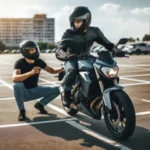
Find an empty parking lot on a Sunday morning. Practice emergency stops from 20 mph. If you never practice this movement, your muscles will tense up and ‘grab’ the lever during a real-world panic stop, which often leads to a locked front wheel and a loss of steering control.
Managing Road Surface Variables
Roads are not uniform tracks. Gravel, oil spills, and painted lines behave differently. Treat every control input—throttle, brake, and steering—as if you are balancing a glass of water. Abrupt movements disrupt the bike’s balance. If you encounter gravel in a turn, stay calm. Do not chop the throttle and do not slam the brakes. Keep your gaze locked on the exit of the turn, not the hazard, to avoid target fixation.
The Look-Where-You-Go Principle

Target fixation is a classic error. Your bike naturally follows your eyes. If you stare at a pothole or a patch of sand, your brain will subconsciously steer you into it. To master this, force your chin to turn toward the exit of a corner. Your body position will naturally follow your head, and the bike will track smoothly through the line you intended to take.
Avoid the Ego Trap
Ego is the biggest risk factor for any rider. Pushing your limits on public roads is how accidents happen. If you feel tense or overwhelmed, dial your speed back by 20%. The road is not a racetrack. If you want to push your limits, sign up for a professional track day or an advanced riding school. Learning proper counter-steering and high-speed cornering techniques in a controlled environment is the fastest way to become a safer, more confident rider.
Actionable Takeaway: The 10-Minute Rule
If you find your mind wandering or feeling fatigued during a long ride, pull over immediately. A 10-minute break is better than a lifelong injury. Keep your focus sharp, your gear maintained, and your eyes scanning. Riding a motorcycle is a skill that requires constant refinement. Keep learning, stay humble, and keep the rubber side down.
Content updated on 2026-09-09