Why Technical Drills Are Your Foundation

You might think raw talent carries athletes, but it is actually the precision of their mechanics. Think of drills as programming the software in your brain. If you skip the fundamentals, your nervous system develops ‘glitches’—inefficient movement patterns that are hard to fix later. Technical drills refine your biomechanics, turning conscious effort into automatic reflexes.
The Biomechanics of Efficient Movement

Every movement you make in sports involves a kinetic chain. This is a sequence of body parts working together, like a whip effect where power starts in your legs and transfers to your hands. If one link is weak, the entire movement collapses. You must isolate these movements to build true efficiency.
The Basketball Crossover: Managing Your Center of Gravity
Many beginners lean too far forward, making them easy targets for defenders. When performing stationary crossovers, keep your center of gravity low and your hips pushed back. This protects your base of support. Imagine sitting in an invisible chair; if you stand too tall, your balance is easily compromised by a slight push.
- Lowering the Hips: Keep your thighs parallel to the floor to maximize explosive power.
- Hand Positioning: Strike the ball slightly to the side rather than directly on top. This creates a wider angle, making the ball harder to steal.
- Eye Level: Keep your chin up. If you look at your feet, your head weight shifts forward and ruins your balance.
Tennis Swing Mechanics: The Importance of the Kinetic Link
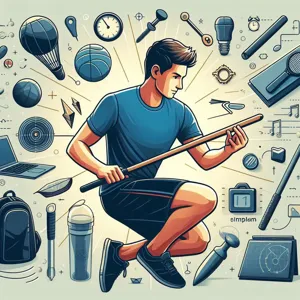
A powerful tennis swing does not come from your arm. It originates from your core rotation. When you perform shadow swings, focus on the ‘unit turn’—rotating your shoulders and hips as one solid block before your arm moves. Think of your torso like a rubber band; the more you twist it before release, the more snap you get on the ball.
- Rotational Force: Your racket speed is a byproduct of your core coil, not your bicep strength.
- Follow-Through Control: Letting your racket finish across your body ensures you did not stop the swing at impact. Stopping early causes the ball to sail long.
- The Contact Point: Keep the ball at a consistent distance from your body. Reaching too far makes your arm a weak lever.
Soccer Ball Mastery: Neurological Mapping
Soccer demands high-frequency micro-adjustments. When you practice inside-outside touches, you are performing ‘proprioceptive training.’ This is how your body learns where it is in space without you looking. Think of it like typing on a keyboard; eventually, your fingers find the letters through muscle memory alone.
- Ankle Stability: Keep your ankle locked when making contact. A ‘floppy’ foot absorbs energy that should go into the ball, leading to unpredictable passes.
- Surface Contact: Use the sweet spot of your instep. Aim for the center of the ball to keep it flat and controlled.
- Repetition Volume: Aim for 100 touches per foot every day. This creates high-density neural pathways that keep your touch ‘soft’ under pressure.
Error Analysis: Common Pitfalls

Even with hard work, you can fall into traps that stunt your development. Avoid these three common mistakes to keep your progression moving forward.
- The Speed-Accuracy Trade-off: Beginners often prioritize speed. This is a mistake. Your brain cannot learn a complex movement if you perform it at 90% intensity before mastering the form. Move at 50% speed until your technique is flawless.
- The Linear Bias: Many athletes only practice in straight lines. Sports are multidimensional. If you only train forward, you lose agility in lateral movements. Incorporate side-to-side shuffling into every warm-up.
- Neglecting Recovery Phases: Your motor cortex requires sleep to lock in new skills. If you train six hours a day without recovery, you aren’t sharpening your skills; you are reinforcing your exhaustion.
Building Your Technical Routine
Consistency creates excellence, not occasional bursts of intensity. Dedicate 20 minutes specifically to these drills before you engage in any competitive practice. This approach ensures your body is fresh enough to learn the correct patterns. Use this breakdown for every session:
- Phase 1: The Activation (5 minutes): Focus on body temperature and mobility, not just sweating. Use dynamic movements like leg swings to wake up your nervous system.
- Phase 2: The Isolated Drill (20 minutes): Pick one specific biomechanical issue. For example, if your soccer pass is inaccurate, spend 20 minutes only on the ‘locking the ankle’ technique.
- Phase 3: The Integration (25 minutes): Now apply that skill in a simulated game environment. If you practiced passing, play a small-sided game where you are restricted to using only your strong foot.
- Phase 4: The Debrief (5 minutes): Reflect on one thing you did well and one movement that felt ‘clunky.’ Addressing the ‘clunkiness’ immediately will prevent it from becoming a long-term habit.
Contenu mis a jour le 2026-08-22