Tennis – How do I develop a strong tennis backhand?

Developing a reliable backhand is often the most significant hurdle for club-level players. While a forehand feels natural, the backhand requires specific structural discipline. Think of your backhand like a support pillar in a building; if the base is weak, the entire structure will buckle under the pressure of a fast-paced rally.
Mastering grip and stance for stability
Your grip acts as the steering wheel for your racket. If your hand placement is inefficient, you are fighting physics before the ball even arrives.
- Eastern Backhand Grip: Place your palm on the top-left bevel of the handle. This is the gold standard for flat, driving shots and offers a stable platform for beginners.
- Continental Grip: Use this primarily for defensive slices. It keeps the racket face open, allowing you to carve under the ball for a low, skidding trajectory.
- Two-Handed Setup: Place your dominant hand in a Continental grip and your non-dominant hand in a semi-western forehand position. This acts as a stabilizer against heavy incoming pace.
Your stance functions as the engine of your swing. You must rotate your shoulders early to coil your torso like a spring. If you fail to turn your chest perpendicular to the net, you are swinging with just your arm. This mistake costs you 30% to 50% of your potential power.
The kinetic chain: Power from the ground up
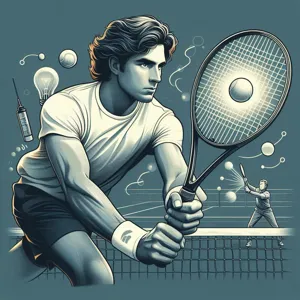
Tennis power does not originate in the bicep. It travels through a kinetic chain, which acts like a whip: energy starts in your feet, moves through your legs, rotates your hips, and finally snaps through your arms.
Steps to execute the kinetic chain correctly:
- The Load: Bend your knees as the ball approaches. Imagine you are compressing a spring.
- The Rotation: Uncoil your hips toward the target. Your chest should be facing the target before the racket head enters the forward swing path.
- The Contact Point: Strike the ball in front of your body at waist height. Striking late—beside your hip—is the primary cause of weak, floating backhands that land in the net.
- Extension: Follow through completely. Your racket should finish high over your opposite shoulder. This ensures you accelerate through the ball instead of stopping at contact.
Two-handed vs. one-handed: A performance analysis
The choice between one and two hands depends on your physical goals and match needs. Data suggests that the two-handed backhand offers a higher consistency rate on high, bouncing balls due to the support provided by the off-hand.
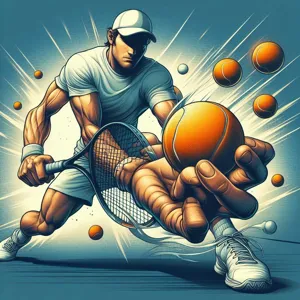
The Two-Handed Advantage: Think of this as a second forehand. It is easier to time and provides superior stability when handling balls above the shoulder. Most modern coaches prioritize this for developing players because it simplifies the mechanics.
The One-Handed Utility: This requires elite timing and core strength. It offers greater reach and allows for better disguising of drop shots. If you choose this path, you must prioritize the unit turn—moving your shoulder and racket as one piece—to keep your timing precise.
Field report: Avoiding the dead arm syndrome
A common mistake I see in recreational play is the dead arm. This occurs when players stop their racket swing immediately upon impact. The ball requires a continuous arc to find depth and spin.

If your shots consistently land short, you are likely failing to finish your swing. Extend your dominant arm fully through the contact zone as if you are reaching out to shake an opponent’s hand across the net. That extra extension is often the difference between a ball hitting the tape and a deep, aggressive groundstroke.
Essential drills for muscle memory
You cannot consciously manage your technique during a high-speed rally. You must train your body until the motion is automatic.
- Mirror Shadow Swings: Practice your rotation in front of a mirror 50 times daily. Focus on keeping your non-dominant hand steady and your weight transfer fluid.
- Wall Rallying: Stand 10 feet from a practice wall. Focus exclusively on your contact point. If your technique is inconsistent, the wall will return the ball at awkward angles.
- Drop-Feed Progression: Drop the ball in front of you and focus on stepping into the shot. This isolates your weight transfer without the added difficulty of gauging an incoming ball’s speed.
Final advice for match play
A strong backhand is not about hitting winners; it is about depth and net clearance. Aim for a target two meters above the net to ensure your ball clears the obstacle reliably. Focus on heavy topspin to pull your opponent wide. Once you achieve this rhythm, the power will emerge naturally. Stay low, track the ball until it hits your strings, and maintain your follow-through to control the rally.
Content updated on 2026-09-22