Selecting the right tennis shoe is not just about brand loyalty or visual appeal. It is a technical decision that affects your lateral stability, injury prevention, and court performance. Think of your shoes as the suspension system of a performance vehicle. If your suspension does not match your driving style or the track surface, you will lose traction and potentially suffer mechanical failure.
Ignoring your specific biomechanics during the selection process often leads to common injuries like plantar fasciitis, ankle sprains, or chronic Achilles tendinitis. Tennis involves intense lateral forces that demand a level of rigidity and support you simply do not find in standard walking or running sneakers.
Identifying Your Foot Type: The Wet Test Method
Credit : whatcanu.com
Before purchasing, you must determine your arch profile. A high arch behaves differently under pressure than a flat arch. Perform the wet test to get a clear data point. Dampen the sole of your foot and step onto a piece of cardboard or construction paper.
Flat Feet (Full Imprint): If you see your entire footprint, your arch is low or collapsed. This leads to overpronation, where the ankle rolls inward during movement.
High Arches (Heel and Ball Only): If you see a narrow band or nothing connecting the heel and ball, your foot is rigid. This results in supination, where the foot rolls outward and lacks natural shock absorption.
Neutral Feet (Half Imprint): If you see a visible curve in the midfoot, your weight distribution is balanced. You require standard support and moderate cushioning.
Technical Requirements by Foot Profile
Once you know your type, focus on the specific structural elements within the shoe’s construction. You are essentially looking for an exoskeleton that complements your foot’s natural tendencies.
Stability Solutions for Flat Feet
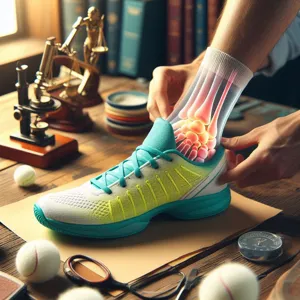
Players with flat feet require a wide base and a high-density midsole. The goal is to prevent the medial (inner) arch from collapsing during aggressive lateral cuts. Look for shoes that feature an external TPU shank—a hard plastic bridge in the middle of the sole. This acts like a structural support beam for your arch. Models such as the Asics Gel-Resolution 9 or the New Balance Fresh Foam Lav V2 are engineered with this increased torsional rigidity.
Cushioning Solutions for High Arches
Credit : whatcanu.com
High-arched feet struggle with impact dissipation because they provide less surface area to absorb ground reaction forces. You need a midsole material that manages energy return effectively. Look for dual-density foams or air units in the heel and forefoot. The Nike Air Zoom Vapor Pro 2 or Yonex Power Cushion Eclipsion 4 are industry benchmarks because they use proprietary materials that act as a hydraulic buffer between your skeleton and the court surface.
Critical Sizing Errors to Avoid
Many amateur players buy tennis shoes using their daily street shoe size. This is a technical error. Tennis involves rapid stops where your foot slides forward inside the shoe due to momentum. If your toes are touching the front of the shoe at rest, you will suffer from subungual hematoma, known as the black toenail syndrome, during match play.
The Thumb Rule: Ensure you have a full thumb’s width of space between your longest toe and the front of the shoe.
Width Matters: If you have wide feet, do not force a narrow shoe. This causes the foot to overhang the midsole, leading to instability and eventual seam blowout on the upper material.
Court Surface and Traction Dynamics
Credit : whatcanu.com
Your outsole choice must be dictated by your playing surface. Using the wrong tread pattern is equivalent to driving a performance car with winter tires on a dry race track.
Hard Court Outsoles: These utilize a modified herringbone pattern with high-density rubber compounds. They are designed to resist abrasion while providing enough grip for hard stops.
Clay Court Outsoles: These require a full, deep herringbone pattern. The design allows you to clear clay out of the grooves while providing the lateral slip required to execute a controlled slide.
Field Experience: Pro-Tips for Longevity
Treat your tennis shoes as high-performance gear. If you play more than three times per week, purchase two pairs and rotate them. Midsole foam needs approximately 24 hours to decompress and return to its original state after use. Rotating your shoes effectively doubles the lifespan of your cushioning system.
Furthermore, never place your shoes in a washing machine. The heat degrades the chemical bonds in the adhesive and ruins the internal foam cells. To clean them, wipe the uppers with a damp cloth and use a soft-bristled brush to remove debris from the outsole. Store them in a cool, dry place to prevent the growth of odor-causing bacteria. Finally, perform a lateral shuffle test in the shop. If your foot shifts inside the shoe before the shoe moves, the fit is insecure, and you risk a lateral ankle sprain during high-intensity play.