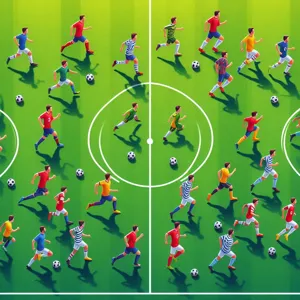
Soccer – What are the different types of soccer formations?
Credit : whatcanu.com
Soccer formations serve as your team’s operating system. They define player positioning, passing lanes, and defensive coverage. Think of a formation like a house floor plan; if the kitchen (midfield) is too far from the dining area (attack), the meal (the ball) gets cold before it arrives.
Selecting a formation requires more than picking a popular number sequence. You must match the structure to your players’ physical and technical profiles. Here is a breakdown of the most effective formations and how they perform in real-world scenarios.
The 4-4-2: Defensive Stability and Simplicity
Credit : whatcanu.com
The 4-4-2 is the most common setup in youth and amateur soccer because of its inherent balance. It uses two lines of four players to cover the pitch width effectively. It is easy to teach and provides immediate defensive security.
Tactical Logic: By maintaining two banks of four, you reduce the space between players. This makes it difficult for opponents to pass through the center.
Field Experience: In a match, the 4-4-2 shines when you are under pressure from a more technical opponent. Leicester City used this to perfection during their 2016 title run. They conceded space in wide areas but forced opponents into low-percentage crosses that their tall center-backs cleared easily.
Common Error: Many coaches place their midfielders too far apart. If your central midfielders aren’t disciplined, they leave a massive hole in the middle. Your players must constantly communicate to maintain a compact block.
The 4-3-3: Mastering Possession and High Pressing
The 4-3-3 is the preferred choice for teams that want to dictate the game. It relies on the geometry of triangles. With three players in each zone, there is almost always a short passing option for the player in possession.
The Anchor Role: Your defensive midfielder is the most vital piece. Think of them as a traffic controller at a busy intersection. They must recycle the ball and protect the defense during turnovers.
Real-World Example: Pep Guardiola’s Manchester City demonstrates this perfectly. They use the 4-3-3 to create numerical overloads on the wings. By keeping wingers glued to the sideline, they stretch the opponent’s defense, creating gaps in the middle for creative midfielders to exploit.
Data Point: Teams that utilize a 4-3-3 typically see a higher percentage of ball recoveries in the attacking third. It is the ideal system if you want to play a high-intensity press.
The 3-5-2: Controlling the Midfield Battle
Credit : whatcanu.com
Moving to a three-man defensive line allows you to add an extra body into the midfield. This is a tactical choice to dominate the middle of the pitch. However, it places immense physical demands on your wing-backs.
The Wing-Back Requirement: These players must cover the entire flank alone. They provide width in attack and become auxiliary defenders when the ball is lost. If they lack the fitness of a long-distance runner, your defense will crumble.
Field Experience: Antonio Conte’s Chelsea side successfully used this to force opponents into the wide channels. By overloading the center, they limited the opponent’s ability to play through the middle, statistically lowering the quality of the chances the opponent created.
The Transition Hazard: The biggest risk is the ‘transition trap.’ If your wing-backs are caught too high up the field when you lose the ball, your three center-backs are often left exposed. You must train your defenders to shift laterally in unison to cover those gaps.
How to Choose the Right Setup for Your Squad
Do not copy a formation just because a professional team uses it. A formation only works if it fits the specific skill sets of your players.
Analyze Your Personnel: If your team lacks fast wingers, a 4-3-3 will fail because you cannot create space out wide. If you have two powerful strikers, a 4-4-2 is better because it allows them to challenge defenders physically.
Audit Fitness Levels: Systems like the 3-5-2 are physically draining. If your squad struggles to maintain intensity for 90 minutes, start with a simpler 4-4-2.
Complexity vs. Execution: A simple formation executed with discipline is always better than a complex system played with hesitation. If your players are uncertain about their roles, they will be half a step slower in every tackle.
Adjusting During the Match
Credit : whatcanu.com
No formation remains rigid from the first whistle to the last. If you are protecting a lead, your priority is closing down space. Instruct your wingers to tuck inside, forming a narrow defensive unit that forces the opponent to play around you.
If you are trailing, you must take risks. Pushing your full-backs into the attacking line creates a 2-3-5 formation. While this leaves you vulnerable to counter-attacks, it forces the opponent’s defense into a chaotic scramble. Success in soccer is rarely about the starting formation; it is about how quickly your team can adapt its shape the moment the ball changes hands.