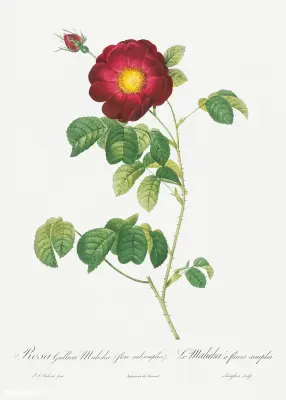
A rose looks complicated because of its layers, but it follows a simple logic: a tight spiral in the center, surrounded by petals that get larger and more open as they move outward. Draw it from the inside out and it becomes much easier.
What you need
- A pencil (an HB for sketching and a 2B or 4B for shading)
- A kneaded eraser, which lifts graphite without damaging the paper
- Smooth drawing paper
- Optional: a blending stump or a tissue, and a real rose or a photo for reference
Step 1: map the overall shape
Lightly sketch a slightly flattened circle or a cup shape for the bloom, and a line for the stem. Keep the lines faint: you will erase most of them.
Step 2: draw the center spiral
Near the top of the circle, draw a small, loose spiral or a curled “S” shape. This is the tightly wrapped center of the flower. Keep it slightly off-center if the rose is seen from an angle.
Step 3: add the first petals around the center
Wrap two or three curved, cupped petals around the spiral. Each petal overlaps the previous one. Draw their top edges with a small fold or curl outward.
Step 4: build outward
Add larger petals around the first ones, working your way to the outline of the circle. Vary their sizes and let some edges curl back. The outer petals open more and can extend beyond your initial circle. Avoid making every petal the same shape.
Step 5: add the base, stem and leaves
Draw the sepals, the small pointed green leaves under the bloom. Add a slightly curved stem, a few thorns, and leaves in groups along the stem. Rose leaves are oval with a pointed tip and serrated edges, with a visible central vein.
Step 6: shade for depth
- Decide where the light comes from.
- Shade the areas deep inside the bloom and where petals overlap: they are the darkest.
- Keep the curled petal edges light.
- Blend gently, then use the eraser to lift highlights.
- Add a soft shadow under the bloom and along one side of the stem.
Common beginner mistakes
- Pressing too hard at the start, making lines hard to erase.
- Drawing a flat outline of every petal instead of overlapping, cupped shapes.
- Symmetry: real roses are irregular.
- Shading everything the same gray: contrast between dark centers and light edges creates the 3D effect.
Practice idea
Draw the same rose three times: once as a quick 5-minute sketch, once from a different angle, and once with full shading. Then try colored pencils or watercolor.