
How weather dynamics dictate American football strategy

In American football, the weather is not merely an external condition; it is a tactical constraint that forces coaches to rebuild their game plans from the ground up. When the forecast changes, the probability of success for specific play-calls shifts mathematically. You can think of weather like a variable in a complex engine: if the temperature drops or the wind picks up, the engine needs different fuel to maintain its performance.
The physics of the passing game in high winds
Wind is the primary enemy of the aerial attack. A gust of 15-20 mph can alter the flight path of a football, particularly on deep routes where the ball spends more time in the air. For a quarterback, this is like trying to thread a needle while someone is blowing on the thread.
- Reduced air distance: Coaches often shift to a shorter, horizontal passing game. Think of quick slants and screens that minimize the ball’s exposure to crosswinds.
- Kicking adjustments: Field goal range shrinks dramatically when kicking into a headwind. A 50-yard kicker might see their effective range drop to 38-40 yards.
- Punting strategy: Punters switch to low, line-drive kicks to minimize the time the wind has to carry the ball, prioritizing field position over hang time.
Ground game dominance: The rain and snow factor

Precipitation creates a high-turnover environment. Wet leather becomes slick, making secure handoffs and ball security the absolute priority. If you watch a game in heavy rain, you will notice a higher frequency of ‘heavy’ personnel groupings, such as using extra tight ends and fullbacks.
Why teams simplify the playbook: A complex passing route requires precise timing between the quarterback and receiver. On a slippery surface, a receiver’s sudden cut can result in a slip, turning a completed pass into a potential interception. Coaches mitigate this risk by relying on the running game, where the ball is tucked away securely and the movement is more linear.
Temperature and the biological limit of performance
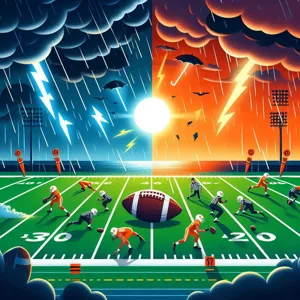
Extreme temperatures impact muscle recovery and player hydration. In heat, the body spends more energy on cooling down than on physical output. Conversely, cold weather causes muscles to contract and stiffen, increasing the risk of soft-tissue injuries.
- The rotation rate: In extreme heat, coaches increase the frequency of player rotations. If a defensive lineman exerts maximum effort for five seconds, they need a longer recovery period before the next snap to maintain their explosiveness.
- Cold-weather muscle management: Teams use heated benches and active movement on the sidelines to keep muscles warm. A stiff muscle is essentially a cold rubber band; it is much more likely to snap under tension than a warm one.
Real-world tactical failures: Lessons from the field
An error I frequently observe is coaches trying to stick to their ‘identity’ when the environment dictates otherwise. For example, a team that relies on a vertical passing attack attempting to maintain that philosophy in a blizzard often suffers a blowout defeat. They ignore the environmental data in favor of a rigid system.

The takeaway: Adaptability is the most valuable trait in football. The winning strategy is the one that minimizes the impact of the weather on your team’s efficiency while forcing the opponent to operate in conditions that conflict with their personnel’s strengths.
Data-driven decision making in modern coaching
Modern NFL teams now employ full-time meteorologists to provide micro-climate updates for their stadium. They track wind shear and humidity levels down to the quarter. This is not just about bringing the right coat; it is about predictive modeling. If the data suggests a high chance of a wet ball in the second half, the offensive coordinator may front-load their passing plays into the first half while the ball is still dry.
Summary of tactical shifts
- High Wind: Shift to a conservative, ball-control passing game and lower-trajectory punts.
- Heavy Rain/Snow: Increase rush attempts; focus on ball security and clock management to limit possessions.
- Extreme Heat: Utilize deeper roster rotations to keep players fresh and prioritize hydration.
- Extreme Cold: Emphasize quick passing to reduce time for defensive pursuit and keep the offense moving to avoid muscle stiffness.
Understanding these adjustments provides a clearer view of why games are won or lost in the trenches before the clock even starts. When you watch your next game, don’t just look at the score. Look at the play-calling sequences in the first quarter—they will tell you exactly what the weather is doing to the coach’s mind.
Content updated on 2026-09-26