Decoding the James Webb Space Telescope: Why It Matters to You
Credit : whatcanu.com
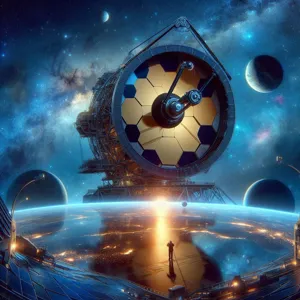
The James Webb Space Telescope (JWST) is not just a bigger version of the Hubble. Think of it as upgrading from a standard smartphone camera to a professional-grade thermal sensor. Its primary role is to act as a cosmic time machine, allowing you to peer back into the early history of the universe.
You might wonder why we need another expensive telescope. Hubble looked at the universe in visible light—the same light your eyes perceive. However, much of the most important action in space is hidden behind massive clouds of cosmic dust. The JWST operates primarily in the infrared spectrum, which lets it peek through that dust to reveal the stars and galaxies hiding behind it.
The Core Mission: Infrared as Your New Set of Eyes
Credit : whatcanu.com
In astronomy, infrared light is the key to distance. Because the universe is expanding, light from the furthest, oldest galaxies is stretched out during its journey toward us. This process is called redshift. Imagine a siren on an ambulance passing you; as it moves away, the pitch drops. Infrared light is essentially that lower pitch, but for light waves.
Without infrared capabilities, these ancient photons would be invisible. The JWST captures these signals that no other observatory can see. Here is how its specific technical advantages translate into scientific breakthroughs:
Piercing Cosmic Fog: The telescope uses infrared light to see through thick dust clouds. It captures the formation of stars in real-time, much like an ultrasound lets a doctor see a fetus through maternal tissue.
Tracing Ancient Origins: By tracking redshifted light, the JWST identifies structures that formed just a few hundred million years after the Big Bang.
Thermal Precision: To catch faint heat signals from the deep universe, the telescope must remain extremely cold. It operates below 50 Kelvin, ensuring its own heat does not swamp the signals it is trying to record.
The L2 Orbit: Why Location is Everything
You often hear that the JWST is parked at the second Lagrange point (L2). This is not just a convenient spot; it is a critical engineering requirement. L2 is a point 1.5 million kilometers from Earth where the telescope can orbit the Sun in sync with our planet.
Credit : whatcanu.com
Practical Advice: Do not fall for the trap of thinking L2 is just a distant parking lot. It is actually a thermal shield. By staying behind Earth, the telescope blocks out the blinding heat radiation from the Sun, the Earth, and the Moon. If it were closer, the infrared mirrors would be overwhelmed by noise, making it useless for deep-space detection.
Transforming Exoplanet Research
We are no longer just counting planets; we are now dissecting their atmospheres. The JWST uses transmission spectroscopy to achieve this. When a planet passes in front of its host star, some starlight filters through the planet’s atmosphere before reaching the telescope.
Chemical Fingerprinting: By breaking down this light, we detect methane, carbon dioxide, and water vapor. It is similar to testing the air quality of a distant room by checking the light filtering through the window.
Cloud Mapping: Recent data has allowed researchers to determine the chemical composition of clouds on exoplanets with startling accuracy.
Habitability Assessment: We can now move from theorizing about potential life to measuring the actual chemical makeup of alien skies.
Engineering Realities and Field Lessons
The JWST is a masterpiece of precision that leaves no room for human error. It features 18 gold-plated hexagonal mirrors that had to unfold perfectly in the vacuum of space. Unlike Hubble, which was serviced by astronauts, the JWST is entirely inaccessible. It had to work perfectly the first time.
Credit : whatcanu.com
Error to Avoid: Do not judge the mission by its early delays. While it faced notorious budget overruns and schedule slips, the data return is already unprecedented. Scientists have had to rewrite entire chapters of galaxy evolution because the JWST provided higher-definition images than our best models ever predicted.
Staying Informed on Recent Discoveries
The telescope is currently performing beyond expectations. While its primary mission was slated for ten years, current projections indicate it could easily operate well into the 2030s. If you want to follow the most exciting findings, look for updates from the JADES program.
The JADES program is currently busy mapping the morphology of early galaxies. We are no longer making guesses about how the first stars ignited. We are actively watching the process unfold through the high-resolution eyes of the JWST. Keep your eyes on these mission updates, as they are redefining our place in the cosmic timeline.