Decoding the Cosmos: Understanding the Different Types of Nebulae
Credit : whatcanu.com
Nebulae are not merely aesthetic deep-space objects. They are the high-stakes engines of the galaxy, functioning as giant recycling plants for interstellar matter. If you want to understand how our universe functions, you must view these clouds as specific stages in the lifecycle of stars. Identifying them correctly allows you to reconstruct the timeline of cosmic evolution.
1. Emission Nebulae: The Stellar Incubators
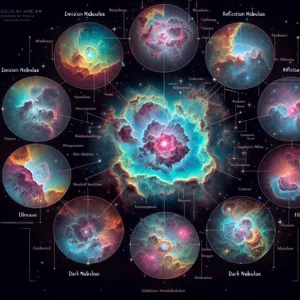
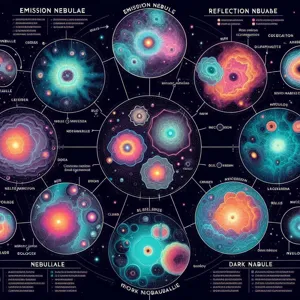
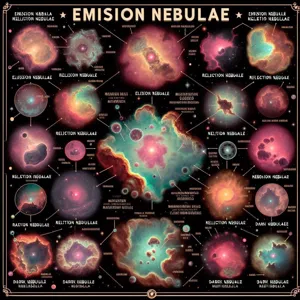
Emission nebulae are active regions where newborn stars ionize surrounding gas. Think of them as a massive neon sign. In a neon light, electricity excites the gas to emit a glow. In space, intense ultraviolet radiation from massive, young stars strips electrons from hydrogen atoms. When these electrons recombine with the atoms, they release a distinct red light, often referred to as the Hydrogen-alpha line.
These structures are remarkably dense with gas, often containing enough material to forge thousands of new stars. The Orion Nebula is the most famous example. When you view it, you are looking at an active production line. If you are using a camera, that vivid red color is not a filter; it is the physical footprint of stellar birth in real-time.
Field Experience: The Common Mistake
Credit : whatcanu.com
Avoid the error of assuming all glowing nebulae are emission-based. A frequent mistake for beginners is confusing the glow of an emission nebula with reflected light. Always check if the nebula has high-energy, hot stars embedded within it. If there are no massive O or B-type stars nearby, the nebula is likely not emitting its own light.
2. Reflection Nebulae: Cosmic Scattering
Reflection nebulae act like dust clouds in a beam of light. They lack the internal energy to ionize gas, so they do not glow on their own. Instead, they scatter light from nearby stars located outside or at the edge of the nebula. This scattering process is identical to how the Earth’s atmosphere creates a blue sky.
Because blue light has shorter wavelengths, it bounces off dust particles more efficiently than red light. Consequently, reflection nebulae usually appear blue. The Pleiades star cluster serves as a textbook example. You are seeing the blue light of the stars reflecting off the remnants of the cloud from which the stars were originally born.
3. Dark Nebulae: The Engines of Gravity
Dark nebulae are massive, opaque clouds of cold dust that absorb all visible light from stars behind them. They act as cosmic silhouettes, appearing as absolute voids in the star-rich Milky Way. While they look empty, they are actually the coldest, densest environments in space, typically hovering near absolute zero.
Credit : whatcanu.com
Think of them as a dense fog on a highway at night. You know the city lights are there, but the fog particles block the path of the photons. These regions are essential because their extreme cold prevents gas pressure from stopping gravity. This creates the perfect, stable environment for gravity to collapse matter into the seeds of future solar systems.
4. Planetary Nebulae: The Final Act
Despite the name, these structures have nothing to do with planets. Early astronomers in the 18th century used low-resolution optics that made these round, glowing shells look like planetary discs. In reality, this is the violent death of a star similar to our Sun.
As a star exhausts its nuclear fuel, it expands into a red giant and sheds its outer layers. This creates an expanding envelope of gas. The remaining core, a white dwarf, emits intense UV radiation that illuminates this shed material for a short period—typically only 20,000 to 50,000 years. It is a fleeting, final display before the material disperses into the interstellar medium.
5. Supernova Remnants: The Heavy Element Factories
Credit : whatcanu.com
Unlike planetary nebulae, which result from a gradual cooling, supernova remnants are the debris from massive, cataclysmic stellar explosions. When a star significantly larger than our Sun dies, it detonates with such force that it creates elements heavier than iron, including gold and silver.
The Crab Nebula is the standard reference for this category. Unlike the relatively smooth expansion of planetary nebulae, supernova remnants are jagged and chaotic. They contain shockwaves that ripple through space at thousands of kilometers per second. These explosions are responsible for seeding the galaxy with the raw chemical ingredients necessary for the formation of rocky planets and complex chemistry.
Technical Strategies for Nebulae Observation
Observing nebulae effectively requires moving beyond the capabilities of the naked eye. Human eyes have poor sensitivity to low-light colors compared to modern digital sensors. To succeed, you must manage light pollution and optimize your equipment.
Aperture Priority: Aim for a minimum aperture of 4 to 6 inches. Light gathering is the primary factor in resolving the faint structure of these clouds.
Spectral Filtering: Invest in OIII (Oxygen III) or UHC (Ultra High Contrast) filters. These isolate the specific wavelengths emitted by nebulae, effectively killing light pollution from city streetlamps.
The New Moon Rule: Never attempt deep-space observation during a full or gibbous moon. Even subtle lunar glow acts as a veil, washing out the delicate contrasts of nebulosity.
Dark Adaptation: Allow your eyes at least 30 minutes to adjust to complete darkness. Every time you check a smartphone screen, you reset your retinal sensitivity, making it impossible to see faint details.
By understanding these categories, you move from simple stargazing to identifying the active processes of the universe. Whether you are observing a stellar nursery or the aftermath of an explosion, you are tracking the transformation of matter on a galactic scale.