Coaxial cable and speaker wire look like they could do the same job, but they are designed for different signals. Coax carries low-power, high-frequency signals, such as TV, internet or digital audio. Speaker wire carries high-power, low-frequency current from an amplifier to the speakers. You can use coax as speaker wire in a pinch, but it is rarely the best choice.
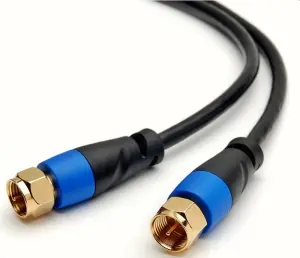
How coax is built
A coaxial cable has a single central conductor, an insulating layer, a metal shield around it and an outer jacket. The shield blocks interference, which matters for weak signals like a TV antenna feed. Common types are RG6, used for cable TV and internet, and thinner RG59.
How speaker wire is built
Speaker wire has two equal conductors side by side, usually stranded copper, with one marked by a stripe, ridge or color to show polarity. What matters is thickness, measured in AWG (American Wire Gauge): lower numbers mean thicker wire and less resistance.
Why coax is a poor speaker cable
- The central conductor of RG6 is roughly 18 AWG, while the shield, which would serve as the second conductor, has a different and often higher resistance.
- For long runs or low-impedance speakers, that resistance wastes power and can soften bass.
- Coax is stiff and harder to connect to binding posts.
For a short run to a small speaker at low volume, it will work. For a home theater or a powerful system, it is not worth the compromise.

Which speaker wire gauge to choose
| Run length (8-ohm speakers) | Suggested gauge |
|---|---|
| up to about 25 feet | 16 AWG |
| about 25 to 50 feet | 14 AWG |
| more than 50 feet | 12 AWG |
With 4-ohm speakers, go one size thicker. Expensive “audiophile” cables add little beyond the right gauge and good connections.
Where coax does belong in audio
- Digital coaxial (S/PDIF) connections between a source and a receiver use a 75-ohm coax cable with RCA plugs.
- Subwoofer cables are often coaxial, since they carry a line-level signal to a powered subwoofer.
- Antennas for FM radio and TV.
Connecting speakers properly
Match positive to positive and negative to negative. Reversing one speaker makes the sound thin and hollow because the two speakers push air in opposite directions. Strip about half an inch of insulation, twist the strands tightly, and use banana plugs or tighten the binding posts firmly. In walls and ceilings, use wire rated CL2 or CL3 for fire safety.
Car systems follow the same logic with different constraints; our guide to choosing a car audio system covers that side.