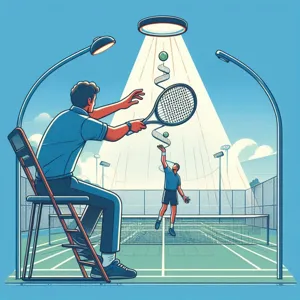
The overhead is the most aggressive shot in tennis. It is a high-reward weapon that demands precision rather than brute force. Most players treat it as a lucky swing, but it is actually a repeatable skill built on three pillars: early preparation, vertical extension, and deliberate placement. If you rely on timing your swing at the last second, you are leaving your success to chance.
The Anatomy of the Trophy Position
Think of your body as a coiled spring. If you do not load your legs and turn your shoulders instantly, that spring stays limp. You need to reach the ‘trophy position’ before the ball reaches its peak.
The Grip: Use a Continental grip exclusively. Hold your racket as if you are shaking hands with it. This grip allows your wrist to rotate naturally, giving you the whip-like snap needed for control.
The Non-Dominant Hand: Use your non-dominant arm as a radar. Point it directly at the ball. This keeps your torso sideways and helps you judge distance accurately. If your arm is down, your shoulders rotate too early, leading to off-center hits.
The Early Unit Turn: As soon as you spot a lob, your feet should move back while your shoulders rotate. Do not wait for the ball to descend. Your racket should be up behind your head before the ball is even halfway to you.
Progressive Drills to Build Reliability
Credit : whatcanu.com
Hitting a few overheads during warm-up is insufficient. You need to build muscle memory through volume and specific constraints. Use these three progressions to move from erratic to elite.
The Side-Step Backpedal Drill
Most errors happen because players run backward. Running backward is like trying to drive a car in reverse at 60 mph; you lose your balance. Practice taking rapid side-steps to get behind the ball. Your goal is to move backward so the ball is always in front of you. Aim to finish your swing moving slightly forward into the court.
The Two-Touch High Point Drill
Credit : whatcanu.com
Start at the service line. Have a partner feed high, arching lobs. Before you swing, reach your racket up and tap the ball softly at the absolute highest point of your extension. Focus on the sensation of full arm length. Do this 20 times without hitting hard. Once you feel the rhythm of catching the ball at the ceiling, add your full swing.
The Baseline-to-Net Transition Drill
Consistency disappears when you are running. Have a partner feed lobs that force you to retreat from the service line toward the baseline. Hit the overhead and immediately sprint back to the service line. This simulates match conditions where the overhead is often followed by another volley. It forces you to prioritize recovery over power.
Field Troubleshooting: Why You Are Missing
Credit : whatcanu.com
If you struggle with the overhead, the problem is usually in the prep, not the swing. Use these tactical checkpoints to self-correct during your next session.
The ‘Net’ Problem: If your shots keep hitting the net, you are likely rushing your wrist snap. You are closing the racket face too early, forcing the ball downward. Focus on keeping the racket face open until the very last millisecond of impact.
The ‘Long’ Problem: If your shots consistently sail past the baseline, your contact point is too far behind your head. Imagine you are reaching to pull a fruit off a high branch. You must strike the ball in front of your body, not over your head.
The ‘Lost Balance’ Problem: If you feel like you are falling backward, check your non-dominant arm. Keeping that arm raised until you contact the ball acts as a counterweight. If it drops to your side, your upper body tips back, sending your shots into the sky.
Tactical Discipline: When to Kill and When to Control
A common mistake is thinking every overhead must be a winner. High-level players view the overhead as a way to end the point on their terms, not necessarily with a single shot. Use these three zones to dictate play effectively.
The ‘Wide’ Strategy: If you are near the center, aim for the deep corner. This pulls your opponent off the court and creates a massive gap for your next shot.
The ‘Feet’ Strategy: If your opponent is standing inside the baseline, aim directly at their feet. It is physically difficult to generate power from a ball hit at your toes.
The ‘Middle’ Strategy: If you are moving or off-balance, hit to the center. It provides the largest margin for error and prevents you from giving your opponent an acute angle to pass you.
Finally, stop trying to crush the ball. An overhead hit at 80 percent power with precise placement is twice as effective as a 100 percent effort that lands in the fence. Focus on clean contact at the peak of your reach, and the power will follow naturally.