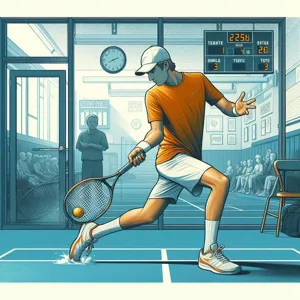
The backhand slice is the most underrated tool in modern tennis. Most club players treat it as a survival shot, but professionals use it to dictate pace, change ball trajectory, and neutralize powerful opponents. Consistency with this stroke comes down to physics and repetition. If you master the mechanics, you transform a defensive liability into a tactical weapon.
The Continental Grip: Your Foundation
Everything starts with your hand placement. Using a forehand grip for a backhand slice is the primary reason for inconsistent, spraying shots. You must adopt the Continental grip. Think of holding your racket like you are shaking hands with it, or gripping a hammer to drive a nail into a wall. This grip naturally keeps the racket face slightly open, which is essential for creating the required backspin without forcing the movement.
Precision Setup: The Unit Turn
Credit : whatcanu.com
Consistency is lost before you even reach the ball. When you recognize a backhand, perform a unit turn immediately. This means your shoulders rotate sideways while your non-dominant hand holds the throat of the racket. This dual-hand grip ensures the racket doesn’t drop too early. Keep the racket high during your preparation. Gravity should help you accelerate downward; starting the swing path too low forces you to scoop the ball, which kills your control.
Mastering the Contact Point
The biggest technical mistake is hitting the back of the ball like a flat groundstroke. Instead, view the contact as a grazing motion. You want to brush the underside of the ball. Imagine your strings are a fine-toothed saw cutting through wood. You do not push the saw into the board; you draw it across the surface with steady pressure.
Front-Loaded Contact: Always make contact in front of your body. If the ball gets even with your hip, you lose your leverage and the shot will float.
The Acceleration Rule: Do not decelerate at impact. Many players “stab” at the ball. Ensure your racket speed remains constant through the entire contact zone.
The Follow-Through: Your racket should finish across your body, pointing toward your target. Stopping the swing abruptly creates “dead” shots without spin.
Proactive Footwork and Balance
Credit : whatcanu.com
A slice is only as good as the feet underneath it. If you are leaning backward, your shot will float like a balloon. Use a step-in motion with your outside foot. This foot acts as a physical anchor. By planting that foot firmly, you create a stable base that allows you to shift your weight forward into the court. This weight transfer is exactly what gives your slice depth and bite.
Avoiding Common Technical Traps
Even seasoned players fall into habits that destroy consistency. Watch for these three killers:
The Head Jerk: Your head must remain still until the ball leaves your strings. If your eyes lift to see the ball’s path too early, your shoulder alignment shifts, causing the ball to sail long.
Ignoring the Off-Hand: Your left arm is a counterbalance. As you swing forward, move your left arm backward. If you keep it tucked against your ribs, your body will rotate too fast, and you will lose control.
Short-Arming the Swing: Never stop the racket immediately after impact. Commit to a full, extended follow-through to ensure the ball lands deep in the opponent’s court.
Drills for Immediate Improvement
Credit : whatcanu.com
Stop playing points to practice your slice. You need volume and controlled focus to build muscle memory.
The Mirror Drill: Shadow swing for five minutes in front of a mirror. Ensure your racket starts above the ball, brushes the underside, and finishes with your chest facing the target.
The Service Line Target: Place a towel inside the service line on your opponent’s side. Attempt to land 20 slices in a row on that towel. Focus on the feeling of the strings gripping the ball.
Wall Reaction Drill: Stand five feet from a wall. Alternate between a backhand volley and a backhand slice. This forces you to switch your grip rapidly and keeps your swing path compact.
Tactical Reality: The Hissing Sound
You know your slice is improving when you hear a distinct “hissing” sound as the ball leaves the strings. That sound is the physical result of friction and backspin. If you hear a “thud,” you are hitting the ball too flatly. Use the slice to force your opponent to hit the ball upward. When you keep the ball below the net tape, they cannot attack you. They are forced to lift the ball, which puts you in the driver’s seat. Be disciplined with your footwork, keep the racket face open, and let the spin do the work for you.