
Several lesbian flags have existed over the years. The one most people use today is the orange, white and pink striped flag, designed in 2018. Knowing the earlier versions helps explain why the community settled on it.

The labrys flag (1999)
Graphic designer Sean Campbell created the first widely known lesbian flag in 1999. It shows a labrys, a double-headed axe linked to Amazon warriors in Greek myth, over an inverted black triangle on a purple background. The black triangle refers to the badge Nazi camps used for women labeled “asocial,” a category that included lesbians. The flag was never adopted very broadly, partly because many lesbians did not identify with the symbols or did not know the designer.
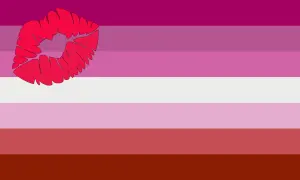
The lipstick lesbian flag (2010)
In 2010, Natalie McCray published a flag in shades of pink and red with a lipstick kiss in the corner. It was criticized for representing only feminine “lipstick” lesbians and for leaving out butch and gender-nonconforming women. Comments attributed to its creator were also seen as excluding some members of the community. A version without the kiss mark circulated for a while, but the design lost support.
The orange-pink flag (2018)
Blogger Emily Gwen shared a new flag in 2018 that quickly became the most common lesbian flag. The original has seven stripes, each with a stated meaning:
- dark orange: gender nonconformity
- orange: independence
- light orange: community
- white: unique relationships to womanhood
- pink: serenity and peace
- dusty pink: love and sex
- dark rose: femininity
A simplified five-stripe version is now widespread, especially on stickers and small items where seven stripes are hard to see. Both versions are accepted; neither is official in a legal sense.
Why flags matter
Pride flags are a quick way to say “you are welcome here” or “this is part of who I am.” The lesbian flag in particular gives visibility to a group that is sometimes overlooked within the broader LGBTQ+ community. It is flown during Pride Month in June and on Lesbian Visibility Day, April 26.
Using the flag respectfully
Anyone can display a pride flag as a sign of support. If you are an ally, the orange-pink flag or the rainbow Progress flag both work. A few common-sense points apply: avoid using a community flag to sell products with no link to the community, avoid altering it into joke versions, and if you run a business or a classroom, make sure the welcome it signals is real. When in doubt, ask the people it represents which version they prefer.