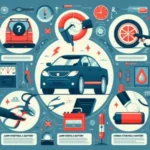
Defensive Driving: Physics-Based Strategies for Hazard Avoidance
Credit : whatcanu.com
Defensive driving is not about passive caution. It is a rigorous application of physics and situational awareness. You must view your vehicle as a mass in motion, subject to traction limits and reaction latencies. Most accidents occur because drivers underestimate the time required to translate a visual stimulus into a mechanical action.
Managing Kinetic Energy and Braking Distance
Credit : whatcanu.com
Stopping distance is the sum of your reaction distance and braking distance. At 60 mph, you cover 88 feet every second. If your reaction time is 1.5 seconds, you travel 132 feet before your foot even touches the pedal. Use the 3-second rule as a baseline, but convert this to a 4-second gap at speeds over 50 mph.
The 4-Second Gap: Increase your following distance as speed increases to account for the square of velocity in kinetic energy calculations.
Braking Efficiency: Keep your heel on the floor to pivot your foot quickly between the accelerator and brake. This minimizes the transition time by milliseconds that save feet of stopping distance.
Wet Surface Traction: Reduce your speed by 30% when roads are wet. Oil residue creates a hydroplaning risk that drastically reduces friction coefficients.
The 15-Second Horizon and Active Scanning
Tunnel vision is the primary cause of late-braking maneuvers. Most drivers fixate on the vehicle immediately ahead. You need to expand your focal length to 15 seconds down the road. Treat your field of vision like a radar sweep.
Micro-Scans: Move your eyes every 2 seconds. Look at the horizon, then the car ahead, then your mirrors. Never lock your gaze on a single point.
Lateral Awareness: Use your side mirrors to identify gaps in adjacent lanes. If you see a vehicle in your blind spot, adjust your speed slightly to move out of that proximity.
Intersection Logic: As you approach an intersection, look left, right, and left again. Assume the cross-traffic vehicle will run the red light. Position your foot over the brake pedal without applying pressure to reduce response latency.
Mastering Vehicle Dynamics in Evasive Maneuvers
Credit : whatcanu.com
If you encounter an emergency, your instinct will be to slam the brakes. In a modern car with Anti-lock Braking Systems (ABS), you must apply firm, constant pressure. Do not pump the brakes. Let the computer handle the rapid modulation of pressure to prevent wheel lockup.
Counter-steering: If your vehicle loses traction, steer gently in the direction you want to travel. Avoid jerky movements that cause weight transfer to overwhelm your tires.
Target Fixation: Do not look at the obstacle you are trying to avoid. Your hands naturally follow your eyes. Look at the clear lane or the escape path, and your hands will instinctively steer you toward safety.
Tire Integrity: Under-inflated tires have more sidewall flex, which increases latency in emergency steering inputs. Check your tire pressure when the tires are cold to ensure you are meeting the manufacturer’s PSI requirements.
The Human Factor: Eliminating Cognitive Load
Driving requires high-level cognitive function. Multi-tasking is a myth. When your brain processes a text message, your situational awareness drops by nearly 40%. This is the equivalent of driving with a delayed neurological response.
The Pre-Drive Setup: Set your navigation, playlist, and climate control before you put the vehicle in drive. Treat these as pre-flight checklists.
External Triggers: If you feel frustration rising, recognize it as a physical state. Lower the cabin temperature and force yourself to breathe deeply. High stress levels impair peripheral vision and fine motor skills.
The 2-Hour Rule: If you are driving for long distances, stop every 2 hours or 100 miles. Micro-sleeps often occur without the driver realizing they have closed their eyes.
Common Mistakes and Field Lessons
Credit : whatcanu.com
I have observed that most professional drivers fall into the trap of ‘habitual complacency.’ They drive the same route daily and stop observing new hazards. Every time you enter your car, reset your mindset to treat the road as if it were a new, unpredictable environment.
The Intersection Trap: Never pull into an intersection until you have a clear path to exit. If you are stuck in the middle during a light change, you become a static target.
The Mirror Bias: Do not rely on technology like blind-spot sensors. They are secondary inputs. Your primary inputs should always be your physical check and visual observation.
Communication Failure: Failing to signal is a failure to manage the behavior of others. Signal 100 feet before your maneuver to give trailing vehicles time to process your intent.
Defensive driving is a disciplined practice of risk management. By adjusting your following distance based on physical data and maintaining a continuous, wide-angle scan of your environment, you regain control over the variables that others often ignore. Focus on the mechanics of your vehicle and the limitations of your own reaction time to ensure your safety on the road.