The Biomechanical Reality of Quarterback Injuries
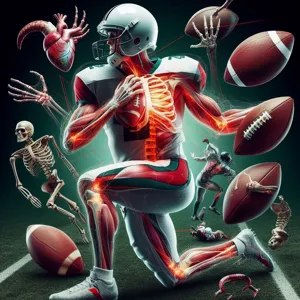
Quarterbacks face a unique physical toll. Unlike skill players who control their movement, quarterbacks are often hit while in a vulnerable, stationary position. Data from the NFL injury surveillance programs indicate that nearly 20% of all quarterback injuries involve the upper extremities, followed closely by knee ligament damage.
Think of the quarterback’s body as a high-performance engine. If the chassis—the hips and core—is misaligned, the engine—the shoulder and arm—must work double time to compensate. This mechanical overload is exactly where most injuries originate.
Rotator Cuff and Labrum: The Limits of Elasticity
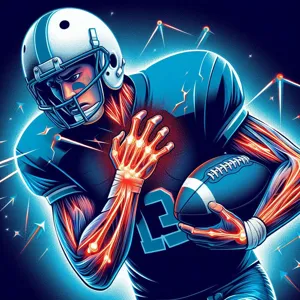
The shoulder joint is a ball-and-socket mechanism held together by a complex system of muscles and tendons. When a quarterback throws, the shoulder undergoes extreme rotational acceleration. Over thousands of reps, this causes micro-trauma.
- Rotator Cuff Tendinopathy: This is essentially fraying the cables of a suspension bridge. Without proper rest, these micro-tears aggregate.
- Labral Tears: The labrum is a cartilage ring that keeps the ball of the shoulder in the socket. A direct hit during the wind-up phase can cause this ring to detach, leading to chronic instability.
Field Advice: If your quarterback complains of ‘dead arm’—a sensation that the ball feels heavier than usual—stop all throwing immediately. Pushing through this sensation is the primary precursor to a season-ending surgical repair.
Lower Body Stability: The Kinetic Chain
Power generation starts from the ground up. If the ankles or knees are compromised, the entire kinetic chain fails. You can liken this to trying to throw a ball while standing on a sheet of ice; if your base slides, your upper body loses all control.
- ACL and MCL Ruptures: These occur most frequently during the ‘sack-and-plant’ scenario. If a defender hits the lateral side of the knee while the foot is fixed in the turf, the ligament reaches its tensile limit and snaps.
- High Ankle Sprains: These involve the syndesmosis ligaments between the tibia and fibula. Because these ligaments are crucial for stability during rotation, even a mild sprain can reduce a quarterback’s lateral agility by 30% for several weeks.
The Reality of Concussion and Neural Fatigue
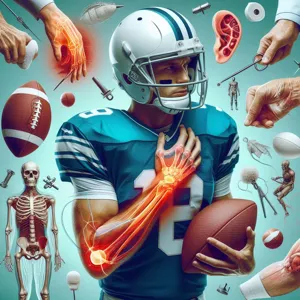
Concussions in quarterbacks are rarely about speed; they are about surprise. A player expecting to throw is biologically unprepared for the force of a 280-pound lineman. This impact causes the brain to shift inside the skull, leading to a temporary chemical imbalance.
Data shows that athletes who return too quickly from a concussion suffer from ‘compensatory injury.’ Because their vestibular system—your internal balance sensor—is slightly off, they change how they move. This puts undue stress on the knees and ankles, creating a secondary injury chain.
Strategic Prevention: Beyond Weightlifting
Strength is not enough to prevent injury. You need functional durability. Implement these three protocols to keep your quarterback on the field:
- Eccentric Loading: Train the muscles to absorb force during the lengthening phase. This prevents the ‘snapping’ effect when a defender pulls a limb during a tackle.
- Hip Mobility Drills: The hips are the primary torque generators. If the hips are stiff, the lumbar spine and shoulders take the load. Focus on internal and external hip rotation daily.
- Pitch Counts: Treat high-school and college quarterbacks like baseball pitchers. Track high-velocity throws during practice. Exceeding 150 high-effort throws per week significantly increases the risk of elbow ligament degradation.
Common Errors and Field Lessons
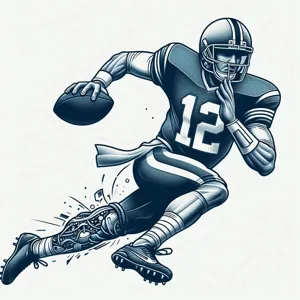
The most common mistake trainers make is prioritizing linear speed over deceleration training. Players are often great at running forward, but they lack the mechanics to stop or change direction safely under pressure.
Avoid the 90% Trap: A player at 90% health is often more dangerous to their own long-term career than a player at 0%. They feel ‘good enough’ to play but lack the stabilization required for high-velocity mechanics. This is where career-altering compensations occur. Always prioritize full range of motion over raw strength during the recovery phase. Without mobility, you have no stability; without stability, you have no durability.
Conclusion
Injuries are an inherent risk in football, but they are not always inevitable. By treating the quarterback’s body as an integrated mechanical system rather than a collection of parts, coaches and players can drastically reduce the severity of these events. Focus on the kinetic chain, manage the load of practice, and respect the biological limits of joint tissue. Your goal is to maximize performance while ensuring the player can function at a high level for years, not just weeks.
Content updated on 2026-09-28