Decoding Feline Hunting Instincts for Play
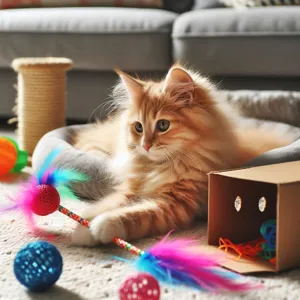
Your cat is a biological machine built for high-speed hunting, not a couch potato. In the wild, cats spend hours tracking, pouncing, and capturing prey. Indoors, this energy has nowhere to go unless you provide an outlet. Without this, your cat defaults to destructive behaviors like shredding furniture or nocturnal pacing.
Think of feline play as a high-intensity interval training (HIIT) session for an athlete. A successful play session should follow the ‘Hunt, Catch, Kill, Eat’ cycle. This mimicry satisfies their hardwired predatory drive and resets their nervous system, leading to better sleep and improved temperament.
The Best Toys for a Cat: Strategic Selection
Not all toys deserve a place in your home. Marketing often prioritizes human aesthetics over feline instincts. You need gear that mimics the unpredictable, erratic movement of living prey. If a toy moves like a bug or a bird, your cat will engage.
Wand Toys: The Gold Standard for Interaction
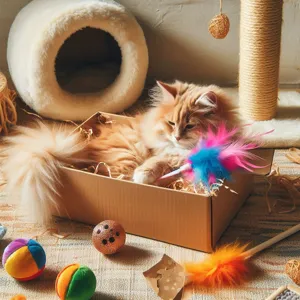
Wand toys remain the most effective tool for bonding and exercise. They allow you to control the speed and direction of the lure. Use the wand to replicate the erratic path of a fleeing mouse. When the toy moves behind an object, it triggers the cat’s stalking instinct far better than an open-floor chase.
- Technique: Keep the toy on the ground. Birds fly, but mice run. Move the lure away from the cat, never directly at them.
- Pro Tip: Allow your cat to ‘kill’ the toy at least once every two minutes. This prevents frustration and builds their confidence as a hunter.
Puzzle Feeders: Solving Boredom
Stop feeding your cat from a static bowl. It turns a hunting animal into a passive consumer. Puzzle feeders require the cat to use their paws and logic to release kibble. This mimics foraging behaviors and slows down rapid eating.
If you don’t have a puzzle toy, use an empty cardboard egg carton. Scatter kibble in the cups. Your cat will have to nudge each piece out individually. It turns a thirty-second meal into ten minutes of cognitive enrichment.
The ‘Bunny-Kick’ Collection
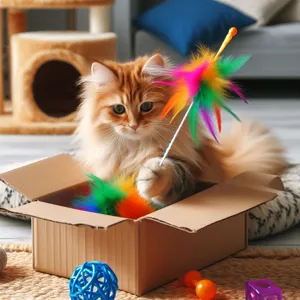
Soft toys are vital for solo play sessions. Choose toys that are roughly the size of a rat. This allows your cat to grab the toy with their front claws and execute the ‘bunny kick’—a rhythmic, powerful thrusting movement of the back legs used to subdue prey.
Look for toys made of durable, woven fabrics. Avoid loose yarn or hair-like fibers that can cause intestinal blockage if swallowed. If you see a thread coming loose, it is already a safety risk. Trim it or discard it immediately.
Mistakes to Avoid During Play
Most owners fall into traps that kill a cat’s interest. Avoid these common errors to ensure long-term engagement.
- The Laser Pointer Trap: Laser pointers are scientifically controversial because they provide no tactile satisfaction. Your cat can never capture the ‘prey.’ If you use one, always end the session by throwing a physical toy for them to catch.
- Toys as Static Decor: A toy left on the living room rug for three days becomes invisible to a cat. Their brains ignore static objects. A toy must move to exist in their world.
- Over-Stimulation: Watch your cat’s tail and ears. If the tail begins to thrash or the ears flatten, they are over-aroused. Give them a cooling-off period before resuming.
Field Tips for Maintaining Interest
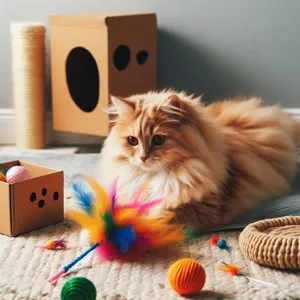
If your cat ignores their toy basket, the problem is not the toys—it is the availability. Cats are highly sensitive to novelty. A toy that is always present becomes ‘background noise’ to a predator.
Implement a rotation system. Keep 80% of your cat’s toys in a sealed bin. Only leave two or three items out at any given time. Swap these toys out once a week. When you pull a ‘new’ item from the bin, your cat will greet it with renewed intensity, as if it were a fresh discovery.
Low-Cost Enrichment Hacks
You do not need to empty your wallet to provide top-tier enrichment. Some of the most effective tools are already in your house.
- The Paper Bag Tunnel: Remove all handles from a brown paper bag to prevent neck entrapment. Lay it on its side to create a dark, crinkly hiding spot.
- Cardboard Architecture: Boxes are not just trash; they are cat bunkers. A stack of three boxes with cut-out holes creates a complex vertical territory.
- Towel Tunnels: Roll up a thick bath towel and secure the ends. The texture and the narrow space are perfect for an ambush attack.
Aim for two 15-minute high-energy play sessions daily. By acting as the ‘prey operator,’ you become the most interesting thing in your cat’s environment. Consistency here is more effective than any single expensive gadget on the market.
Content updated on 2026-10-14