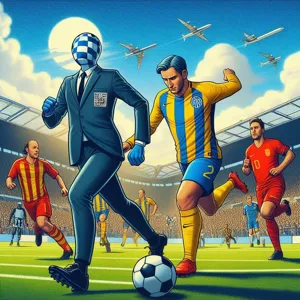
The introduction of the Video Assistant Referee (VAR) represents the most significant shift in soccer officiating since the game’s inception. While sold as a cure for human error, the system has created a profound identity crisis. You are likely familiar with the frustration of a perfectly timed celebration being halted by a silent review, or a game’s momentum grinding to a total standstill. But is the trade-off for precision actually killing the spirit of the sport?
The Illusion of Perfection
VAR operates on a simple premise: justice must be absolute. However, soccer has never been a sport of binary outcomes. It is a game defined by fluid movement, subjective fouls, and the chaotic beauty of human imperfection. When you apply high-definition, slow-motion scrutiny to a sport played at high speed, you create a paradox. You are essentially using a microscope to judge an impressionist painting. By prioritizing technical accuracy over the game’s natural rhythm, the system often strips away the spontaneity that makes soccer thrilling.
The Reality of Performance Disruption
Credit : whatcanu.com
Beyond the philosophical debate, there is a tangible impact on the pitch. Soccer is a rhythm-based sport. For players, maintaining physical and mental intensity for 90 minutes is essential. Frequent, long-winded VAR checks act like a circuit breaker in a home electrical panel. When the power goes out mid-match, it is incredibly difficult for players to recover their focus. This is an error in implementation that often goes ignored: the cost of a delay is not just time lost; it is the physical cooling down of athletes, which increases the risk of injury and tactical stagnation.
Common Pitfalls in VAR Execution
If you have ever coached or analyzed a match, you have likely noticed these persistent issues:
The Threshold Problem: Referees often fail to define what constitutes a ‘clear and obvious’ error. This leads to inconsistency where two nearly identical tackles result in two different VAR outcomes.
The Lack of Transparency: Unlike rugby, where fans can hear the officials discuss the decision, soccer keeps spectators in the dark. Silence in the stadium breeds resentment.
The Over-Reliance Syndrome: On-field officials are increasingly hesitant to make firm decisions, subconsciously waiting for a signal from the video booth. This erodes the authority of the referee on the grass.
The Human Cost of Technological Intervention
Credit : whatcanu.com
Consider the fan experience. You go to a match to share a communal emotional spike—the goal celebration. When that moment is delayed by several minutes for a check, the emotion is rarely recaptured. It is replaced by a clinical waiting period. From a professional standpoint, we are seeing a disconnect between the officials in the booth and the reality on the ground. A slow-motion replay of a collision often makes a ‘normal’ footballing incident look like a deliberate act of violence. This creates a distorted reality that doesn’t reflect the true nature of a competitive tackle.
How to Fix the System
The solution isn’t necessarily to scrap VAR, but to fundamentally change its role. Here are three actionable improvements:
Limit Review Times: Implement a ‘shot clock’ for reviews. If the video team cannot find a clear error within 60 seconds, the original decision must stand. This forces them to prioritize obvious errors only.
Broadcast the Audio: Give fans access to the conversation between the ref and the VAR. If you want us to trust the process, show us the logic behind the decision.
Empower the On-Field Referee: Stop the video booth from micro-managing. The official who is physically present in the match atmosphere should retain the final say on all subjective calls.
Learning from Other Leagues
Credit : whatcanu.com
Rugby provides a masterclass in how to integrate technology without killing the soul of the sport. In rugby, the TMO (Television Match Official) is an advisor, not a master. The communication is audible to the stadium, and the interaction is fast. Soccer currently operates with the rigidity of a bureaucratic machine. We are treating the game like a mathematical equation rather than a narrative sport.
The Verdict: Can We Save the Game?
VAR is not going anywhere, but it must evolve from a master back into a servant. We have to decide if we want our sport to be perfectly officiated or if we want it to remain the dynamic, emotional, and unpredictable spectacle that defined it for a century. If we continue on this path of endless intervention, we risk turning soccer into a series of stop-start video checks. The future of the game depends on finding a balance where technology supports the referee without replacing the human drama that makes soccer worth watching.