Modern soccer has reached a tipping point where set-pieces, specifically direct free kicks, are fundamentally altering match outcomes. Data from the last five seasons in Europe’s top five leagues reveals a significant trend: teams are prioritizing set-piece efficiency over high-volume open-play attacks. This shift suggests that free kicks are no longer just a restart; they are becoming a disproportionately powerful weapon.
The Math of the Dead Ball
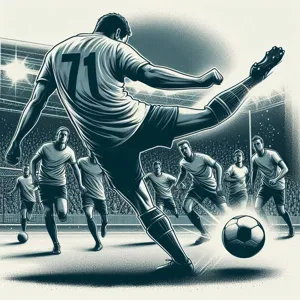
Consider the physics of a modern match ball like the Adidas Pro series. These balls are engineered with smoother surfaces and thermal bonding, which reduces drag. Think of it like a Formula 1 car with perfect aerodynamics; the ball experiences less resistance, allowing it to move in unpredictable patterns during flight. This is the Magnus effect in action—the ball spins, creating a pressure difference that makes it swerve or dip abruptly.
Credit : whatcanu.com
When a specialist like James Ward-Prowse or Kevin De Bruyne strikes the ball from 25 yards, the success rate is rising because the defensive wall cannot account for these flight variations. Statistics indicate that an elite free-kick taker now converts roughly 6% to 8% of direct attempts from outside the box. While this seems low, it is statistically superior to the average expected goals (xG) of an open-play shot from the same distance, which often hovers around 3% to 4%.
The Defensive Failure: Why Walls Are Losing
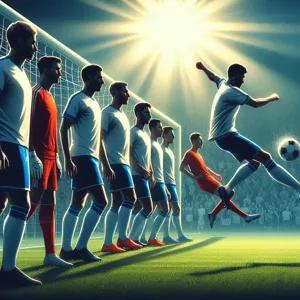
Many defensive units are failing because they rely on outdated positioning protocols. You are likely coaching or playing with the standard wall placement: four players, hands behind backs, jumping at the moment of impact. This is effectively a static target for the attacker.
The ‘Sightline’ Error
The most common mistake is the goalkeeper hiding behind the wall. If your keeper cannot see the ball clearly until it clears the wall, they lose approximately 0.2 seconds of reaction time. In professional soccer, the ball travels at speeds exceeding 70 mph. Losing 0.2 seconds means the difference between a save and a goal.
Goalkeeper Priority: The goalkeeper must be the sole director of the wall. They must identify the kicker’s preferred angle and shift the wall three yards toward the short side.
The Anti-Wall Pivot: Use one player to lie behind the wall to prevent the low, driven shot. This allows the standing wall to jump aggressively without fearing the ball sliding underneath them.
Distraction Management: Modern attackers often place their own players in the wall to disrupt balance. Defenders must maintain physical discipline rather than getting into shoving matches.
The Rise of the Set-Piece Specialist
Credit : whatcanu.com
The game has moved into an era of granular specialization. Clubs now employ dedicated set-piece coaches whose entire job is to analyze the ‘optimal striking zone’ of opponents. They use high-speed cameras to record the goalkeeper’s movement patterns before a foul is even called.
Think of this like a quarterback studying a defensive playbook. By identifying a goalkeeper’s tendency to take a ‘pre-step’ to the left, the kicker knows exactly where to aim to exploit that reflex. When elite attackers and specialized coaches combine, the defense is forced into a reactive state, losing control of the initiative.
Tactical Reality: Is the Game Overbalanced?
The primary critique is that teams now hunt for fouls near the penalty area as a deliberate strategy. This reduces soccer to a game of tactical fouls rather than creative flow. However, we must view this through a pragmatic lens. A foul is a defensive mistake. If the attacking team forces the defense into an error, they deserve the reward of a high-value set-piece opportunity.
Credit : whatcanu.com
The issue is not the power of the kick, but the lack of defensive evolution. To counter this, defensive units must implement ‘zone-based’ marking during set-pieces that forces attackers into wide, low-percentage shooting angles. Do not allow a clean look at the center of the goal.
Actionable Advice for Coaches
If you want to neutralize the threat of the free kick in your league, implement these three rules immediately:
Force the Weak Foot: Identify if the kicker is one-dimensional. Ensure your wall forces them to shoot with their non-dominant foot by shifting the wall positioning early.
The Two-Man Wall Concept: For shots from 30+ yards, stop building massive walls that block your keeper’s vision. Use a smaller, two-man wall and let the keeper manage the angle.
Communication Drills: Practice wall setup under pressure. Your players should be able to form a functional wall in under five seconds. Slow reactions are exactly what specialists are looking for.
Free kicks are not becoming too powerful; they are becoming more professionalized. The advantage currently sits with the attacker because they are innovating faster than the defense. By adopting a more analytical approach to wall construction and goalkeeper positioning, you can flip the script and restore the balance of the game.