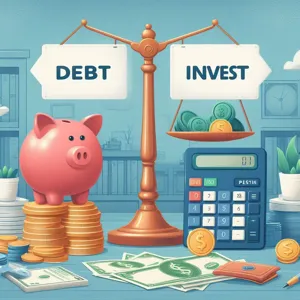
Should I pay off debt or invest? A professional financial breakdown
Credit : whatcanu.com
Deciding between paying off debt and investing is often framed as a lifestyle choice. In reality, it is a mathematical puzzle where one wrong move costs you thousands in lost compound interest. You need a rigid system to prioritize your capital, or you risk stagnating your net worth.
Think of your net worth like a leaking boat. Debt is the water entering the vessel, while investments are the patches keeping it afloat. If the water comes in faster than you can patch the holes, you will sink regardless of how much equipment you add. Let’s look at the hard numbers and the strategy that actually builds wealth.
The mathematical filter: Quantifying the cost of capital
Credit : whatcanu.com
To make the right choice, you must compare the interest rate on your debt against the expected return of your investments. Do not use guesses; use your actual loan statements and realistic market averages.
High-interest debt (above 7%): This includes credit cards, payday loans, and private personal loans. Paying off a 19% credit card is equivalent to a guaranteed 19% tax-free investment return. There is no stock market portfolio that can match that guaranteed gain. Prioritize these aggressively.
Low-interest debt (below 5%): These loans are essentially “cheap” money. If you hold a mortgage at 3.5%, and the S&P 500 returns 8% over a decade, you net a 4.5% gain by investing instead of overpaying your principal. The math favors investing here.
Case Study: Imagine you have $10,000 in credit card debt at 20% interest. By paying it off, you save $2,000 in interest in one year. If you invested that $10,000 instead at an 8% return, you would only earn $800. The debt repayment is objectively the superior financial move.
The foundational requirement: The emergency buffer
Credit : whatcanu.com
Never bypass your safety net to pay debt or invest. An emergency fund is your firewall against high-interest debt traps. If your car breaks down without this cash, you will be forced to use credit, resetting your financial clock.
The target: Set aside 3 to 6 months of essential living expenses.
The location: Keep this in a High-Yield Savings Account (HYSA). It must be liquid, meaning you can pull the cash in 24 hours.
The logic: This isn’t about return; it’s about insurance. A 4% yield in an HYSA is acceptable because you are buying peace of mind.
The golden rule: Capturing the employer match
There is one exception to the “debt-first” rule. If your employer offers a 401(k) or pension match, you must take it. This is a 100% instant return on your capital. If you contribute $3,000 and the company matches it, you have $6,000. No debt payoff can mathematically outrun a 100% immediate gain.
Behavioral reality: Why spreadsheets don’t tell the whole story
Credit : whatcanu.com
Finance is 80% habit and 20% math. You might be mathematically better off keeping a low-interest student loan, but if the debt causes you chronic stress, you will make poor impulsive decisions elsewhere. If owing money hinders your focus or your sleep, pay it off. The mental clarity you gain is often worth the “cost” of lost potential interest.
Field Experience: Many people fail because they aim for 100% austerity. They cut their budget to zero to pay off debt, burn out after two months, and then quit the entire plan. Allocate 10% of your disposable income to “wants” so you can sustain your habits for the long haul.
Your step-by-step priority list
Follow this exact sequence to ensure your money works as hard as possible:
Employer Match: Contribute to your retirement plan until you hit the maximum company match.
Emergency Fund: Build your liquid cash reserve for basic survival.
Investing: Direct surplus cash into diversified index funds or ETFs.
Low-Interest Debt: Pay down these balances gradually, as your cash flow allows.
Common traps to avoid in your journey
The Market Timing Trap: Do not hoard cash to pay off debt hoping for a stock market crash. You will likely miss the recovery. Consistent investing beats lucky timing every single time.
Tax Neglect: Always calculate the post-tax cost of your debt. If you can deduct mortgage interest from your taxes, the effective interest rate of your mortgage is lower than the nominal rate. This further supports the argument to keep low-interest debt while investing.
The “All-or-Nothing” Fallacy: You do not have to choose one path exclusively. Most successful individuals adopt a hybrid model, splitting their extra income between debt repayment and investment accounts. This balance keeps your portfolio growing while your debt burden slowly shrinks.