Mastering Camera Settings for High-Speed Action
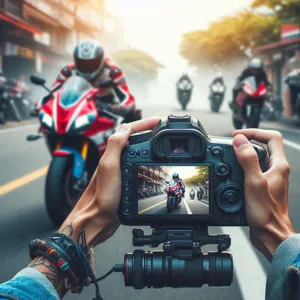
Capturing a motorbike at high speed requires moving beyond Auto mode. Think of your camera as a professional athlete; it needs specific instructions to track motion effectively. Start by switching to Shutter Priority mode (Tv or S). For a bike moving across your field of vision, set your shutter speed to at least 1/1000th of a second to freeze the action.
If the light is dim, increase your ISO but cap it at 3200. Beyond this, you encounter digital noise, which is the digital equivalent of fine sand ruining the clarity of your image. Your autofocus must be set to Continuous AF (AF-C or AI Servo). This acts like a radar lock that constantly recalculates the distance as the bike travels toward you.
The Panning Technique: Conveying True Velocity
Freezing a bike entirely often makes it look like it is parked on the track. To show actual speed, you need panning. This is the art of moving your camera in perfect sync with the bike. Imagine watching a tennis match; your eyes move with the ball to keep it in focus while the background stays out of view.
- Lower your shutter speed to between 1/60th and 1/125th of a second.
- Find your subject early and track the bike well before the shutter clicks.
- Rotate your body from your hips to maintain a fluid, arc-like motion.
- Keep the bike in the same spot in your viewfinder throughout the entire swing.
- Follow through: continue moving the camera even after the photo is captured.
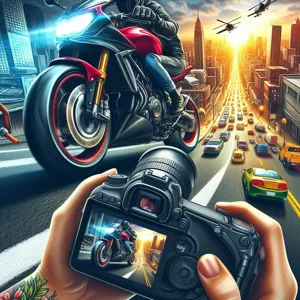
When you master this, the bike stays sharp while the background turns into long, horizontal streaks. It is a visual cue that tricks the viewer’s brain into feeling the speed of the motorcycle.
Selecting the Right Lens for the Shot
Your lens choice dictates the emotional impact of your photography. A 70-200mm zoom lens is the industry standard for track work. It allows you to stay behind safety barriers while compressing the visual distance between the subject and the background. This compression makes the rider look larger than life.
For static shots, use a 35mm or 50mm prime lens. These lenses mimic human vision and allow for a wider aperture. This creates shallow depth of field, or bokeh, where the background turns into a soft blur. This forces the viewer to focus entirely on the mechanical details of the bike.
Professional Video Stability and Cinematic Motion
Shaky footage is the fastest way to lose your audience. If you are filming from a chase vehicle, a 3-axis gimbal is your most important tool. It acts like a high-end car suspension, absorbing bumps and vibrations to keep the camera level.
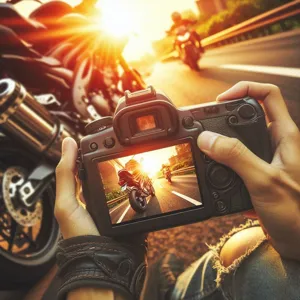
For a cinematic look, shoot at 60fps or 120fps. This gives you the option to slow down footage for dramatic effect. A slow-motion shot of a rider leaning into a corner captures the machine’s grace in a way real-time video cannot. Always follow the 180-degree rule: your shutter speed should be double your frame rate to ensure natural motion blur.
Common Pitfalls and Field Lessons
I have seen many photographers waste hours of track time because they ignored basic logistics. Learn from these recurring field errors to improve your workflow immediately.
- The Dead-Center Trap: Placing the bike in the middle of the frame is static. Use the rule of thirds. Place the bike at the intersection of your grid lines to give it visual room to accelerate.
- Ignoring Background Clutter: A high-performance bike looks cheap if framed against trash or spectator fences. Scout your angles. A clean background makes the bike’s silhouette pop.
- Over-Processing: Do not rely on heavy presets to save a bad shot. High contrast often destroys detail in the highlights. Aim for natural color correction that respects the bike’s aesthetic.
- Safety Protocols: Never stand on the outside of a corner. If a rider loses traction, the bike will slide outward toward you. Position yourself on the inside of the bend or behind sturdy barriers.
Capturing Character Beyond the Machine
Do not just photograph the machine; photograph the story. Capture close-ups of the helmet visor reflecting the asphalt or the heat shimmer rising from the engine. These details provide the context needed for a compelling narrative.
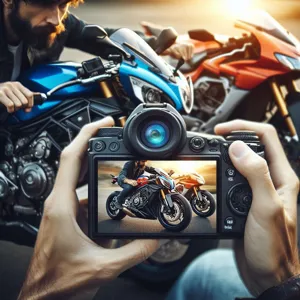
Finally, leverage light to your advantage. The golden hour, just after sunrise or before sunset, provides soft, directional light that emphasizes the curves of the bike. If you must shoot at midday, use a circular polarizer. It cuts reflections on the gas tank, removing glare to reveal the true paint job underneath.
Strategic Planning for Video Production
When recording video, vary your shot list to keep the audience engaged. Mix wide shots that establish the environment with tight close-ups of the rider’s inputs. A wide shot shows the scale of the track, while a close-up on the gloved hand working the clutch shows the intensity of the rider’s focus.
Always verify your audio levels if you are capturing trackside sound. Use an external microphone with a wind-muff, as track wind is significantly louder than it seems. Great motorcycle video is an immersive experience where the audio quality should match the visual clarity.
Final Pro Tip: The Pre-Capture Routine
Before the session begins, walk the track area to identify where riders brake and where they accelerate. Set your camera positions based on these zones. Anticipating the bike’s movement is the secret difference between an amateur snapshot and professional-grade content.
Content updated on 2026-09-07