Define Your Workflow and Essential Hardware
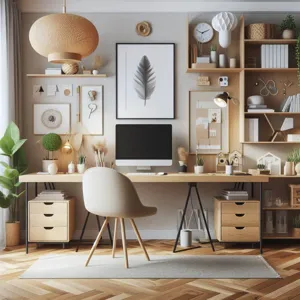
A functional home office starts with a clear assessment of your physical footprint. If you spend 8 hours a day in front of a screen, your priority must be ergonomics. A standard desk height is 29-30 inches, but if you are taller or shorter, this can lead to chronic strain. Invest in a height-adjustable desk—look for models like the Fully Jarvis or Uplift V2—that allow you to toggle between sitting and standing every 60 minutes.
For equipment, if you manage data-heavy projects, a dual-monitor setup (two 27-inch 1440p displays) is the gold standard for efficiency. It prevents the need to switch tabs constantly, saving an estimated 10-15 minutes of focus time per hour. If your work involves video calls, invest in a dedicated 1080p webcam and a ring light positioned at eye level to avoid unflattering shadows.
Ergonomics: The Professional Standard
Your chair is your most critical investment. Avoid ‘executive’ leather chairs that lack adjustability. Instead, choose an ergonomic task chair with:
- Adjustable Lumbar Support: Crucial to prevent lower back curvature over time.
- 4D Armrests: They must adjust in height, width, depth, and angle to support your forearms and prevent shoulder tension.
- Seat Depth Adjustment: Ensure there is a two-finger gap between the edge of the seat and the back of your knees.
Optimize Your Layout for Deep Work
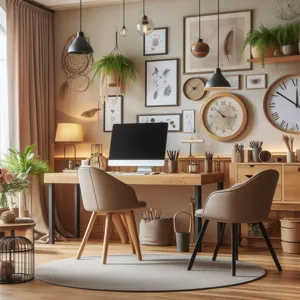
Positioning your desk relative to your windows can dictate your energy levels. Never face a window directly; the glare on your screen will cause eye strain by mid-afternoon. If possible, place your desk perpendicular to the window to receive soft, natural side-lighting. If you are working in a shared space, use a high-backed decorative screen or a tall bookshelf filled with plants to create a visual barrier that signals you are in focus mode.
The Golden Rule of Organization
Clutter is a cognitive tax. Use the ‘Landing Strip’ method: your desk surface should only hold what you use daily—keyboard, mouse, monitor, and one notebook. Everything else must have a home in a drawer or cabinet. Invest in cable management kits—specifically cable sleeves and under-desk trays—to hide the ‘wire jungle’ that makes any space look chaotic regardless of the furniture price tag.
Strategic Lighting and Color Psychology
Lighting should be layered to avoid fatigue. Use a 4000K (neutral white) light source for tasks. A desk lamp with an adjustable neck allows you to direct light exactly where you need it without creating screen reflection. For ambiance, use warm 2700K LED strips behind your monitors to reduce the contrast between your screen and the surrounding wall, which significantly eases eye strain during evening work.
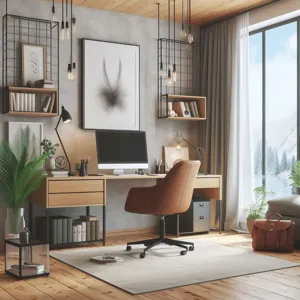
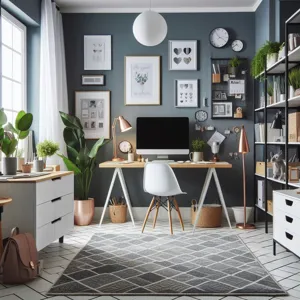
For colors, avoid pure white, which can feel clinical and cold. Opt for ‘greige’ or soft sage green. These neutrals are proven to be less distracting than high-contrast colors and provide a professional, calm backdrop for Zoom calls. If you need a creative boost, add one accent wall in a deep navy; it provides depth without being overstimulating.
Budgeting for Long-term ROI
Do not spend 50% of your budget on aesthetics and 50% on utility. Flip that ratio. Spend 70% of your budget on your chair and desk, as these are health investments. Use the remaining 30% for decor, plants, and organizational tools. You can find high-quality used office furniture from commercial liquidators—these professional-grade items are built to last 10+ years, unlike cheap consumer-grade desks that wobble within six months.
Common Pitfalls and Field Experience
The ‘Dining Table’ Trap: Never treat your dining or kitchen table as a permanent office. The chair height is wrong, and the lack of dedicated storage means you end up working in a mess. If space is limited, use a wall-mounted fold-out desk that hides your work completely at 6 PM.
The Temperature Mistake: Most home offices are poorly ventilated. If your room gets hot, your focus drops. Use a small, silent desktop fan to keep airflow circulating. Stagnant air leads to brain fog faster than any other environmental factor.
The Lighting Error: Overhead ceiling lights are your enemy. They create harsh glare and fatigue. Rely on task-specific lighting exclusively once the sun sets. Your eyes will remain fresh for two hours longer than they would under a bright, overhead bulb.
Maintaining Your Sanctuary
Treat your workspace like a professional office. At the end of every Friday, spend 10 minutes performing a ‘hard reset.’ Clear the desk of all stray papers, wipe the screens with a microfiber cloth, and refill your supplies. Starting Monday morning with a clean slate prevents the procrastination that stems from seeing a messy workspace from the previous week.
Content updated on 2026-10-12