Decoding Golf Course Architecture: Why Surface Matters
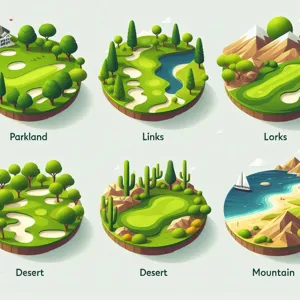
Golf is not a static game played on identical fields. The architecture of the ground beneath your feet dictates the physics of your ball flight and the strategy of every shot. Treating a links course like a parkland layout is a technical error that ruins your scorecard before the first tee. You must understand how design nuances influence your mechanics to play effectively.
Links Courses: The Physics of Firm Ground
Links golf evolved on coastal dunes where the soil is sand-based and porous. This foundation creates a firm surface that demands a specific ground-based game. Think of playing links golf like playing billiards on a felt table versus a carpet; the ball is meant to interact with the terrain, not just fly over it.
- Ground Game Strategy: You must prioritize the ‘bump and run.’ Use the natural slopes of the fairways to feed the ball toward the hole.
- Wind Penetration: Because the turf is firm, the ball rolls out significantly. Keep your trajectory low to prevent the wind from grabbing your shot and stalling your distance.
- Pot Bunkers: These are not modern scoops in the sand. They are deep, steep-walled pits designed to punish poor accuracy. If you land in one, your goal is survival, not glory. Play out sideways if you have to.
Parkland Courses: The Geometry of Precision

Parkland courses define the standard inland layout. These environments feature lush soil, heavy vegetation, and distinct corridors created by mature tree lines. The challenge here is not the wind, but the claustrophobic nature of the fairways.
Field Tip: If your natural ball flight is a slice, you will lose balls in the forest. You must adjust your aim to the left edge of the fairway to account for that curvature. Accuracy off the tee is worth more than twenty extra yards of distance here.
Desert Golf: Target-Oriented Play
Desert courses turn the fairway into an island. You are playing on a curated piece of land carved out of an arid ecosystem. The transition from fairway to desert scrub is instantaneous and unforgiving.
- Hard-Pan Mechanics: The dirt outside the green is often baked and rock-hard. Do not attempt a standard wedge shot from these surfaces. You will likely bounce the club leading edge into the ball, leading to a thin, blade shot. Use a putter or a hybrid to chip from these areas.
- Gear Protection: The desert floor is full of rocks and debris. Hitting a full iron shot from the waste area will likely gouge your club soles or even damage the shaft. If you are in the scrub, take the penalty drop.
Championship vs. Executive: The Training Perspective
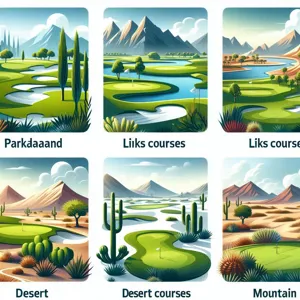
Golfers often conflate length with difficulty. A championship course, measuring over 7,000 yards, tests your ability to sustain long-iron accuracy and physical endurance over four hours. It is a test of attrition.
Executive layouts act as a laboratory for your short game. Because these courses feature a higher concentration of par-3s and par-4s, you face more opportunities to refine your wedge play. If your handicap has stalled, move your practice to an executive course. You will hit ten approach shots in one round here compared to three or four on a championship layout.
Resort Courses: Deception by Design
Resort layouts prioritize the aesthetic experience. Designers use vibrant flowers, wide water features, and manicured landscaping to make the round feel inviting. However, the width of the fairways is often a trap.

Error to Avoid: Do not fall for the wide landing zones. Designers often place water hazards or bunkers exactly where a golfer’s comfort zone ends. Look at your yardage book for forced carries. If a water hazard sits 200 yards out, calculate if you can truly carry it. If not, play short to the fat part of the fairway. Ego-driven shots here result in high-penalty rounds.
Action Plan for Skill Development
Choose your course based on the specific gap in your game this month. Strategic selection accelerates progress better than generic range time.
- Fixing Driver Accuracy: Play parkland courses. The narrow corridors demand straight, controlled shots, forcing you to dial in your setup and alignment.
- Mastering Ball Flight: Play links or exposed layouts. You cannot fight the wind; you must learn to punch the ball under it and use side-spin to hold your line.
- Improving Putting Feel: Use courses with consistent green speeds. Whether it is bentgrass or Bermuda, playing the same type of surface for four consecutive rounds builds the muscle memory needed for distance control.
The best golfers do not play the course; they play their own game within the constraints of the architecture. Analyze the ground, assess your risks, and execute the simplest shot that gets you to the next target. Leave the heroics for when you have a clear statistical advantage.
Content updated on 2026-09-16