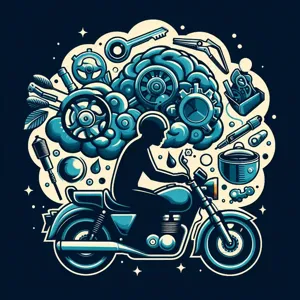
The Physiological and Cognitive Benefits of Motorcycling
Credit : whatcanu.com
Riding a motorcycle is often mischaracterized as a high-risk leisure activity. However, from a biomechanical and neurobiological perspective, operating a motorcycle is a complex task that demands high-level cognitive engagement and sustained physical exertion. By treating your time on the bike as a targeted activity rather than a simple commute, you can unlock significant gains in focus, muscular endurance, and mental resilience.
Cognitive Engagement and Neurobiological Gains
Operating a motorcycle requires active sensory processing. Unlike driving a car, where you are insulated from the environment, riding forces your brain to constantly filter data. This is what neuroscientists call high-attention state processing.
Heightened Situational Awareness: You must process road conditions, traffic patterns, and mechanical feedback simultaneously. This acts as a form of cognitive training, improving your reaction time and spatial intelligence over time.
The Flow State: Riding often induces a state of ‘flow’—a mental zone where the challenge matches your skill level. Studies suggest that entering this state reduces the production of cortisol, the body’s primary stress hormone, effectively clearing mental clutter.
Dopamine Release: The physical act of leaning into a corner and accelerating triggers a natural release of dopamine. This neurotransmitter is linked to reward and motivation, which explains why riders often feel significantly more alert and positive post-ride.
Practical Application: The Meditation Analogy
Credit : whatcanu.com
Think of riding like a physical version of meditation. In traditional mindfulness, you focus on your breath to ignore distractions. On a bike, the physical necessity of balancing and navigation forces your focus onto the present. If you let your mind wander, you fail to navigate. This forced present-moment focus is why riders often feel mentally ‘reset’ after a session.
Physical Conditioning: More Than Just Sitting
A common misconception is that the motorcycle does all the work. In reality, the rider acts as an active suspension component. Depending on the machine, you are performing a constant, low-intensity isometric workout.
Core Stabilization: Your obliques and lower abdominals are under constant tension to maintain equilibrium, especially during low-speed maneuvers. This acts as a dynamic ‘plank’ exercise.
Isometric Leg Engagement: You are using your inner thighs and knees to grip the fuel tank for stability. This improves hip adductor strength, which is essential for pelvic stability and back health.
Upper Body Mechanics: Managing the handlebars requires micro-adjustments from your shoulders and triceps, which improves muscular endurance in the upper back and neck areas.
Field Experience: Managing Physical Load
Credit : whatcanu.com
A classic error beginners make is ‘death-gripping’ the handlebars. This leads to premature fatigue and hand numbness. Pro-tip: Keep your elbows bent and your weight supported by your core, not your wrists. If you feel like your arms are doing the heavy lifting, you are putting unnecessary strain on your tendons and reducing your bike’s handling precision.
Mitigating Risks Through Proper Equipment
The health benefits of riding are only relevant if you maintain your physical safety. Think of your gear as your ‘life-support system.’ It is not just for protection; it is to prevent environmental fatigue.
Ear Protection: Wind noise at highway speeds can reach 100 decibels. Over time, this causes auditory fatigue, which increases irritability. Use high-fidelity motorcycle earplugs to reduce decibels without losing situational awareness.
Temperature Regulation: Heat exhaustion or hypothermia can impair your decision-making speed. Use base layers that wick moisture to keep your core temperature stable.
Helmet Fitment: A helmet that is too heavy or poorly fitted will cause neck strain. Ensure your helmet is ECE 22.06 or Snell-certified for the best weight-to-protection ratio.
Actionable Routine for New Riders
Credit : whatcanu.com
To maximize the health benefits, treat your riding like a planned training session. Start by practicing in a controlled environment, such as a large empty parking lot, to build muscle memory before moving to high-traffic areas.
Warm-up: Perform basic neck and shoulder rolls before mounting your bike to ensure your range of motion is optimal.
Hydration: Dehydration reduces focus. Drink water before you ride, as the wind chill often masks how much fluid you are losing.
Review: After a long ride, perform a quick ‘mental audit.’ Note which parts of your body felt fatigued. If it was your lower back, adjust your posture or consider a different handlebar rise for your bike.
Ultimately, motorcycling is a discipline. When managed with intentionality, it serves as a robust tool for improving your physical coordination and mental clarity. By acknowledging the technical demands of the ride and preparing your body accordingly, you turn a simple trip into a genuine health-promoting activity.