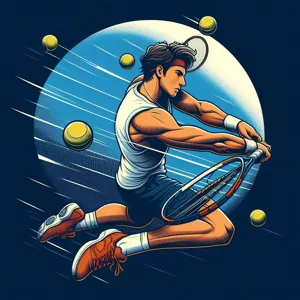
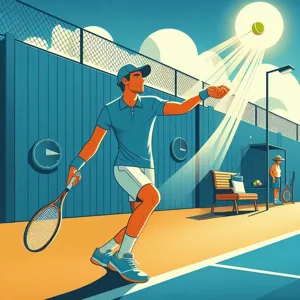
The slice serve is your primary weapon for controlling court geometry. Unlike a flat serve that depends on raw velocity, the slice uses lateral spin to manipulate the ball’s trajectory and bounce. Think of the slice serve like a professional pool player using English on the cue ball to bank a shot. The spin allows you to move the opponent wide, force errors, or jam them on their body.
The Mechanics of Rotation
To generate effective slice, you must prioritize racket head speed over power. The goal is to move the racket edges around the side of the ball rather than driving through the back of it. Most players fail because they try to force the ball with their arm, which kills the necessary friction.
The Continental Grip: You must use a Continental grip, often called the chopper grip. Imagine you are holding a hammer to drive a nail into a wall. This grip naturally keeps your racket face slightly open at contact, which is essential for sidespin.
The Toss Adjustment: If your toss is too far in front, your body alignment forces a flat motion. Toss the ball slightly to the right of your body for a right-handed player. This allows your racket to travel across the back of the ball from 8 o’clock toward 2 o’clock.
Advanced Drill: The Fence Brush
Credit : whatcanu.com
If you struggle to understand the contact point, find a practice fence. Stand sideways to the fence, about two feet away. Practice your service motion by brushing the racket head against the fence links. If you hear a grinding noise, you are brushing the ball correctly. If you hear a sharp metallic bang, you are hitting the fence flat. This provides instant feedback on your angle of attack.
The Low-Bounce Advantage
The core benefit of the slice is the low skid upon impact. When the ball hits the court with heavy sidespin, the friction causes it to stay lower than a flat or topspin serve. This forces your opponent to strike the ball from below the level of the net. When an opponent hits from below the net, they have a limited margin of error and cannot hit down on the ball to create power.
Common Pitfalls and Fixes
Credit : whatcanu.com
Technical errors are often caused by body tension. If your serves are consistently floating, you are likely stopping your swing too early. Treat your racket like a whip. The handle starts the motion, but the racket head must accelerate through the contact point to generate the spin required to curve the ball.
The Dead Arm Syndrome: If your serve lacks bite, you are likely pushing the ball. Focus on a fluid, fast swing speed even on your second serve. If you slow down, the ball will not spin enough to stay in the court.
Shoulder Alignment: Many players rotate their chest toward the net too early. Keep your shoulders perpendicular to the baseline as long as possible. This stores kinetic energy, similar to a coiled spring, which you release during the contact phase.
Tactical Application in Match Conditions
Use the slice serve when your opponent is comfortable on the baseline. The change of pace disrupts their rhythm. Target the wide side of the deuce court to pull your opponent off the court, leaving the rest of the court open for your next shot.
Credit : whatcanu.com
Field Experience Tip: If your opponent has a weak backhand, serve the slice into their body. This forces them to decide whether to hit a backhand or move their feet to take it as a forehand. Most amateur players struggle with this decision-making process under pressure, leading to a weak return.
Structuring Your Practice Sessions
Do not simply hit buckets of balls without a clear objective. Quality of practice dictates your rate of improvement. Use this simple structure to track your progress:
Warm-up: Spend 5 minutes hitting serves at 50% speed, focusing solely on the feel of the ball against the strings.
The Box Drill: Divide the service box into three zones: wide, body, and T. Hit ten serves to each zone. Keep a notebook and write down your completion percentage for each.
Pressure Set: Finish your session by playing a tie-break game where your serve only counts if you land a slice serve. If you hit a flat serve, you lose the point automatically. This forces you to trust your slice under pressure.
Consistency is the byproduct of repetition under specific constraints. Stop trying to hit the fastest serve possible. Instead, focus on hitting the most difficult serve for your opponent to return. A 70mph slice that lands wide is infinitely more valuable than a 90mph flat serve hit directly into your opponent’s strike zone.