The Sun as the Solar System’s Gravitational Anchor
Credit : whatcanu.com
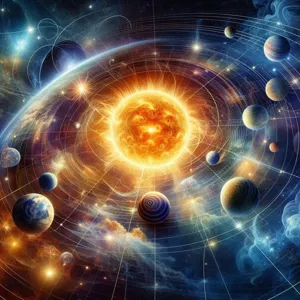
To understand the solar system, stop viewing the Sun as just a light bulb in the sky. It is a massive gravitational anchor. The Sun accounts for 99.86% of the total mass of the solar system. Imagine a heavy bowling ball placed in the center of a stretched fabric sheet; the Sun bends the fabric of space-time, forcing everything from Mercury to the furthest Kuiper Belt objects to follow a set path.
This mass creates a gravitational well that dictates the orbital velocity of every planet. If the Sun were replaced by an object with even 10% less mass, Earth’s orbital speed would drop, and our planet would spiral into a colder, distant orbit. This stability is the primary reason the solar system has remained organized for approximately 4.6 billion years.
The Physics of Orbital Stability
Centripetal Balance: The Sun’s gravity pulls planets inward, while their forward motion pushes them outward, creating a perfect circular balance.
Debris Clearing: The Sun’s massive gravity acts as a vacuum, pulling in or ejecting rogue asteroids that might otherwise collide with the inner planets.
Predictable Rhythm: The Sun’s mass ensures that orbital periods remain consistent, allowing for the precise measurement of time and seasons on Earth.
Nuclear Fusion: Powering a Planetary Engine
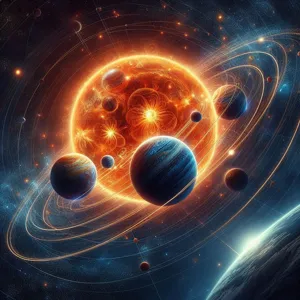
The Sun is a fusion reactor, not a fire. In its core, the temperature reaches 15 million degrees Celsius. At this extreme heat, hydrogen atoms are crushed into helium, releasing energy in the process. This reaction converts 600 million tons of hydrogen into 596 million tons of helium every single second.
Credit : whatcanu.com
The missing 4 million tons of matter is converted directly into pure energy. This energy output is approximately 3.8 x 10^26 watts. To put this in perspective, this is equivalent to the simultaneous detonation of 100 billion megaton hydrogen bombs every second. Without this continuous output, Earth would reach near-absolute zero temperatures within weeks.
Why Energy Transfer Matters
Energy does not reach us instantly. Photons created in the core take between 10,000 and 170,000 years to reach the surface through a process called a random walk. Once they escape the surface, they reach Earth in just 8 minutes and 20 seconds. This delay ensures the Earth receives a steady, constant stream of solar radiation rather than violent, irregular bursts.
The Solar Engine: Driving Weather and Climate
The Sun is the direct engine behind every weather event you experience. Solar radiation hits the Earth unevenly due to the curvature of our planet and its 23.5-degree axial tilt. This leads to massive temperature gradients between the equator and the poles.
Credit : whatcanu.com
Because nature seeks equilibrium, it forces the atmosphere to shift heat from warm zones to cold ones. This movement of air masses is exactly what creates wind and global circulation patterns. Without this solar-driven pump, the Earth’s atmosphere would be stagnant, and our oceans would lose the currents that distribute nutrients and regulate global temperatures.
The Vulnerability of Modern Infrastructure
Solar weather is an engineering risk you cannot ignore. The Sun constantly emits a stream of charged particles known as the solar wind. Occasionally, magnetic field lines on the Sun snap, causing Coronal Mass Ejections (CMEs). These are literal explosions that blast billions of tons of ionized gas into space at millions of miles per hour.
When these particles strike Earth’s magnetic field, they cause geomagnetic storms. Here is the operational reality of how this affects you:
Power Grid Overload: Intense currents can flow through high-voltage transmission lines, potentially melting transformers and causing widespread blackouts.
Satellite Drag: Increased solar radiation heats the upper atmosphere, causing it to expand. This increases drag on satellites, which can lead to premature orbital decay.
Signal Distortion: Solar flares interfere with high-frequency radio waves, disrupting GPS accuracy and satellite-based communication systems.
Credit : whatcanu.com
Field Note: A classic error in risk management is assuming that space weather only impacts scientists. In 1989, a severe solar storm knocked out the entire power grid in Quebec, Canada, in just 90 seconds. Infrastructure managers now treat solar activity as a primary variable in grid resiliency.
The Lifecycle of Our Primary Energy Source
The Sun is currently in its main-sequence phase, consuming hydrogen steadily. It has enough fuel to continue this stable output for roughly 5 billion years. Eventually, the hydrogen in its core will be exhausted, causing the Sun to transition into a red giant and finally collapse into a white dwarf.
Understanding this life cycle is critical for long-term space strategy. We are currently living in a stable window, but human civilization must rely on the data provided by probes like the Parker Solar Probe to monitor the Sun’s evolving behavior. Treat solar observation as a form of long-term insurance for the survival of Earth’s technological and biological systems.