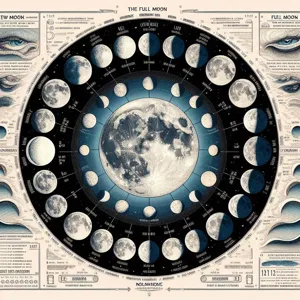
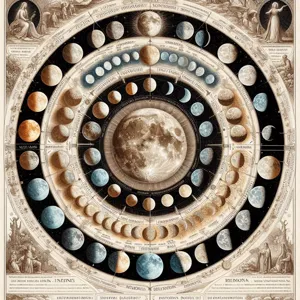
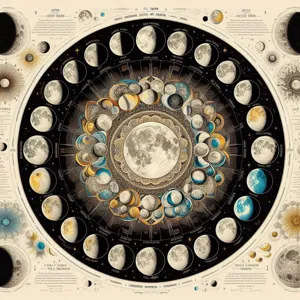
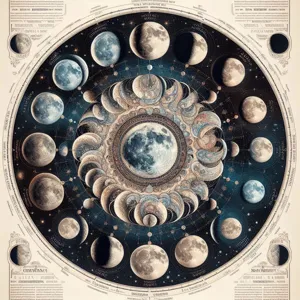
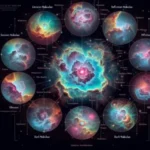
The Moon does not emit light. Think of it as a giant, spherical mirror floating in space. It reflects sunlight, and your view of that reflected light depends entirely on the geometric alignment of the Sun, the Earth, and the Moon. As the Moon completes its 29.5-day orbit, our line of sight changes. This simple shift in perspective creates the eight distinct lunar phases you see from your backyard.
The Anatomy of Lunar Progression
Credit : whatcanu.com
Tracking the lunar cycle is like watching a biological clock wind down and reset. You transition from total darkness to peak brilliance and back again. Understanding this rhythm requires viewing the Moon as a dynamic light-sensitive object rather than a static fixture in the sky.
New Moon: The Moon is positioned between the Earth and the Sun. The illuminated side faces away from us, leaving the Moon invisible in the night sky.
Waxing Crescent: As the Moon moves in its orbit, a thin sliver of reflected light appears on the right edge. The term waxing means the light is growing.
First Quarter: The Moon has reached a 90-degree angle relative to the Sun. You see exactly half of the lunar disk illuminated.
Waxing Gibbous: More than half the disk is visible. It is bulging—the literal definition of gibbous—as it approaches full intensity.
Full Moon: The Earth sits between the Sun and the Moon. We see the entire face of the Moon fully illuminated by the Sun.
Waning Gibbous: The light begins to decrease, or wane. The illumination shifts to the left side as the cycle moves toward completion.
Third Quarter: Similar to the First Quarter, the Moon is at a 90-degree angle, but we now see the opposite side illuminated.
Waning Crescent: Only a small sliver remains visible on the left edge before the cycle resets to the New Moon phase.
The Geometry of Light: Why the Moon Changes Shape
Beginners often mistakenly believe that the Moon’s shape changes because of Earth’s shadow. That is an eclipse, not a lunar phase. A lunar phase is simply a change in how much of the sunlit half of the Moon is visible to you. Imagine holding a ball in a dark room and shining a flashlight on it. As you move around the ball, the amount of light you see on its surface changes. The geometry remains constant; your vantage point is the only variable.
Practical Field Tactics for Observers
Credit : whatcanu.com
You do not need an expensive observatory to analyze the lunar surface. Use these professional techniques to improve your observation efficiency.
Prioritize the Terminator Line: This is the boundary between the light and dark hemispheres. It is the best place to view detail because sunlight hits the craters at an angle, creating long, deep, and distinct shadows.
The Binocular Advantage: Skip the entry-level telescope. Start with 10×50 binoculars. They provide a wide field of view that is much easier to stabilize, allowing you to map surface features effectively.
Avoid the Full Moon for Detail: The Full Moon is the most overrated time for detailed observation. The light hits the surface head-on, washing out shadows and leaving the terrain looking flat and uninteresting.
Synchronize with Timing: Use a lunar app to track moonrise and moonset. A New Moon rises with the Sun, whereas a Full Moon rises exactly as the Sun sets. Plan your sessions accordingly to maximize your view.
Common Mistakes and Real-World Experience
Many amateur astronomers associate the Moon’s phases with changes in gravitational pull or tidal behavior. This is an error. The Moon’s gravity remains constant regardless of its illuminated phase. Tides are dictated by the Moon’s proximity and the Earth’s rotation, not by the amount of reflected sunlight.
Credit : whatcanu.com
Another common mistake is attempting to observe the Moon during poor atmospheric seeing conditions. If the air is turbulent—look at the stars; if they are twinkling rapidly, the air is unstable—your magnification will be useless. Wait for a night when the stars appear steady. This small adjustment will improve the sharpness of your lunar images by a factor of three or four.
Predictive Astronomy in Your Backyard
By learning these eight phases, you move from passive viewing to active tracking. You start to anticipate when the shadows will be perfect for a specific crater or when the sky will be dark enough for deep-space photography. The lunar cycle is a predictable, reliable, and constant tool. Mastery of these movements allows you to decode the mechanics of the solar system without ever needing specialized equipment beyond a basic pair of binoculars.